What is Domain Rating (DR) and does it matter for a new site?
You launch your product. Someone in a founder group says "nice, but your DR is only 3." Another directory proudly shows "DR 72" on its submit page. Suddenly everyone is talking about a number you have never checked.

Divv Saxena
Founder & Flight Director • October 13, 2026
You launch your product. Someone in a founder group says "nice, but your DR is only 3." Another directory proudly shows "DR 72" on its submit page. Suddenly everyone is talking about a number you have never checked.
So what is Domain Rating, and should you, a maker with a brand new site, actually care? Short answer: it is a useful signal, but it is not a Google ranking factor and it is not something to obsess over in your first few months. Let's break it down in plain words.
What is Domain Rating?
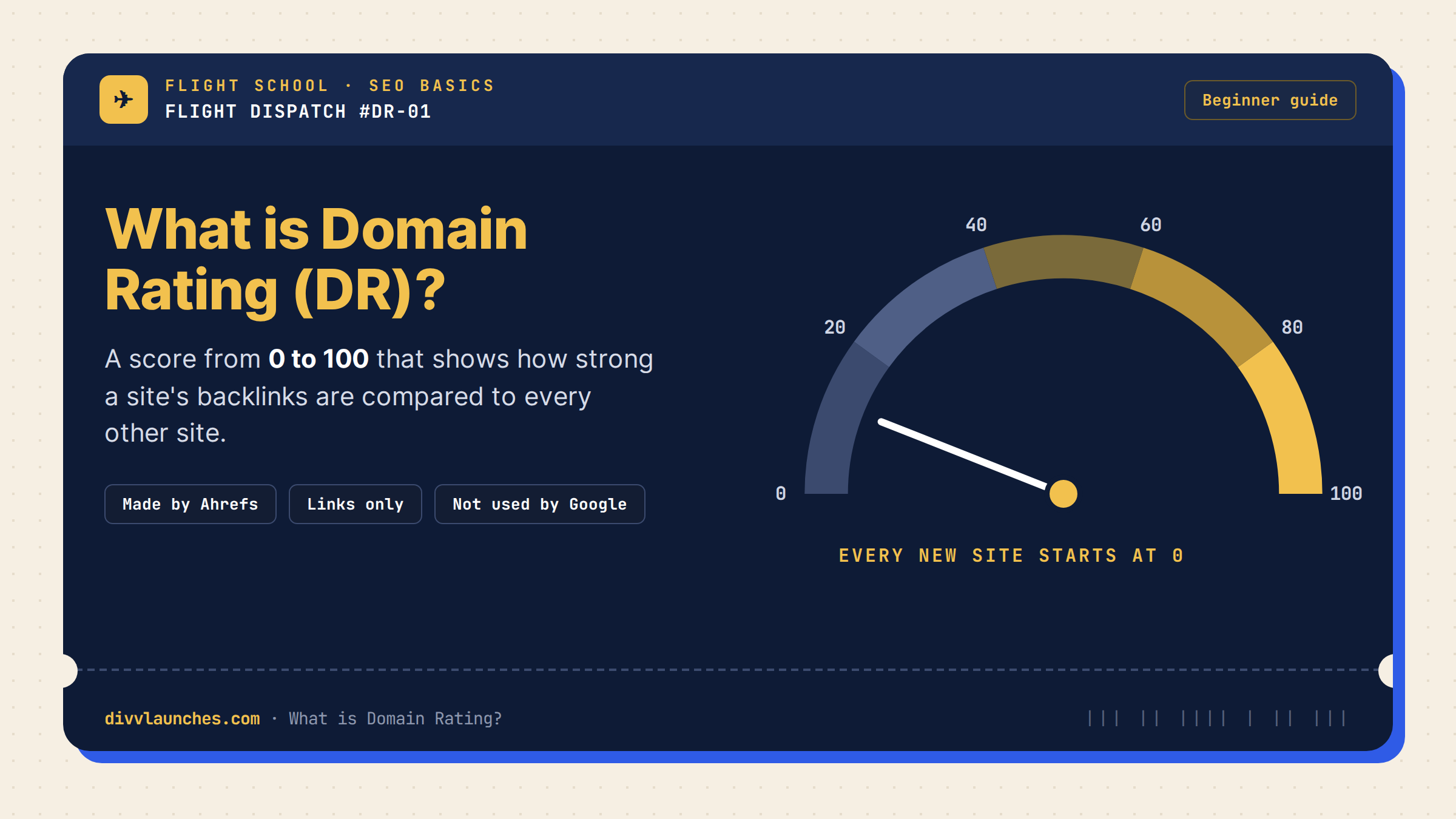
Domain Rating, or DR, is a score from 0 to 100 made by the SEO tool Ahrefs. It tells you how strong a website's backlink profile is compared to every other site in Ahrefs' database.
Think of it like a popularity score among websites. If lots of trusted sites link to you, your DR goes up. If almost nobody links to you, it stays near zero.
Two things to remember from day one:
- DR is only about links. It does not look at your traffic, your design, your content quality or how many users you have.
- DR is relative. Ahrefs itself says you cannot call 30 or 50 a "good" DR on its own. It only makes sense when you compare it to similar sites.
How DR is worked out (the simple version)
Ahrefs looks at every website that links to you with a dofollow link. Then it asks two questions about each one.
- 1How strong is that linking site? A link from a high DR site carries more weight.
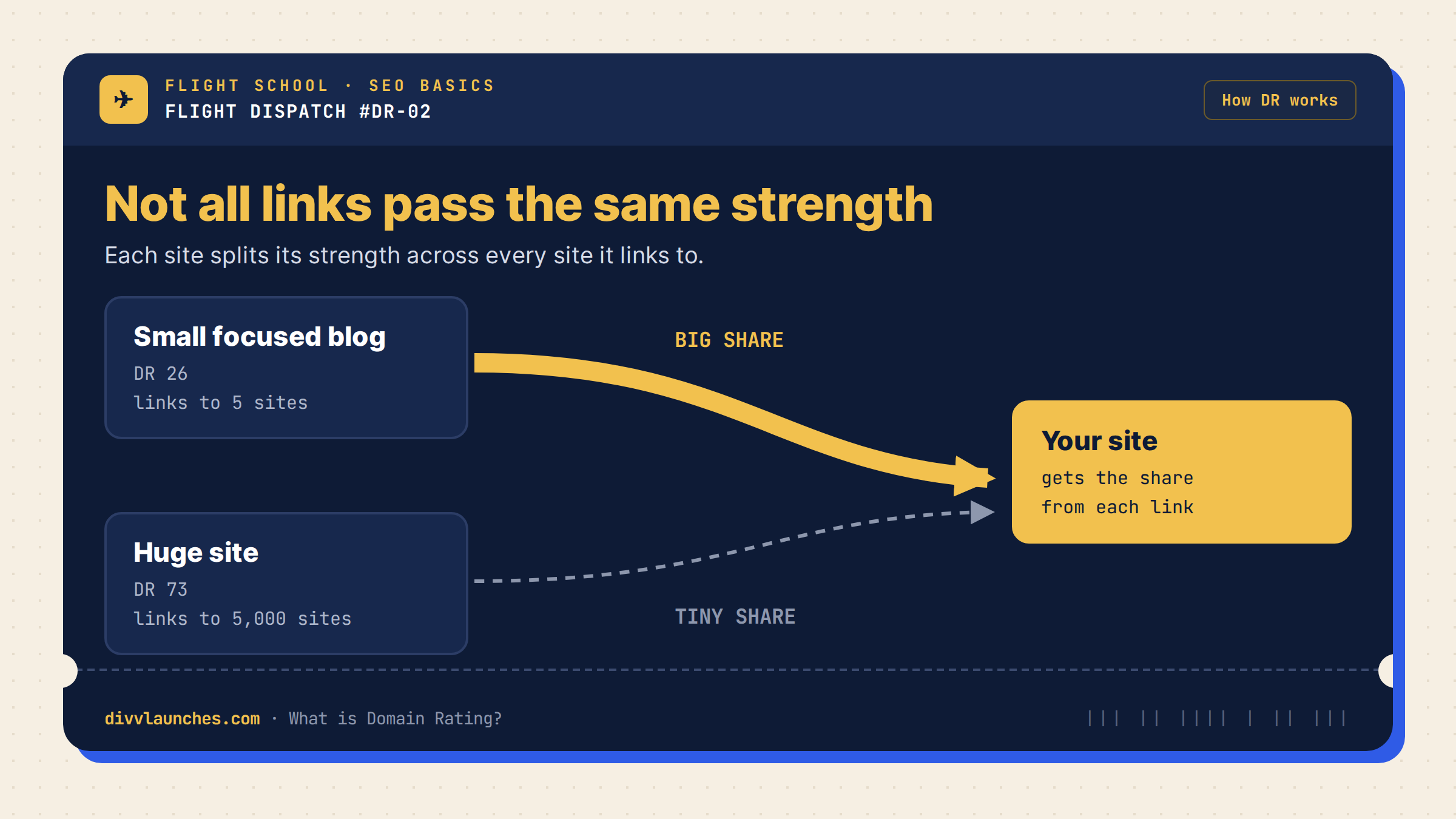
- 2How many other sites does it link to? A site shares its strength across everyone it links to. So a site that links to 5 domains passes on more than one that links to 5,000.
This is why a link from a small, focused DR 26 blog can help you more than a link from a huge DR 73 site that links out to thousands of places. Ahrefs gives almost this exact example in its own help docs.
A few more rules that surprise beginners:
- Only the first link from a site counts. Ten links from the same website add the same DR as one link.
- Nofollow links do not count. If you read our backlink beginner guide, you already know the difference.
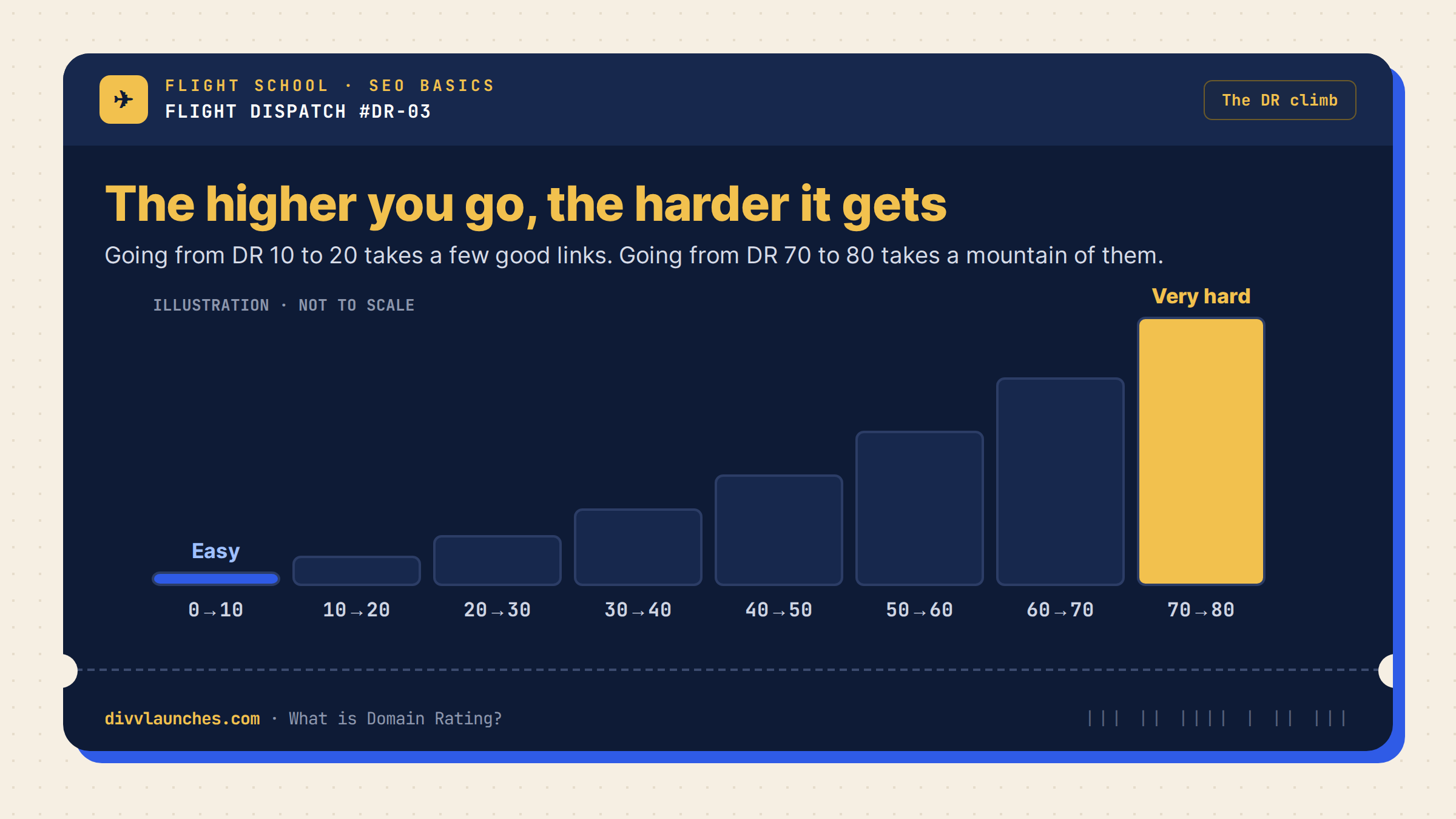
- The scale gets harder as you climb. Moving from DR 10 to 20 is fairly easy. Moving from DR 70 to 80 takes far more links from far stronger sites.
- Your DR can drop without you doing anything. Since it is relative, if other sites grow faster than you, your number can slip.
DR vs DA vs Authority Score
DR is not the only score out there. Each big SEO tool has its own version, built from its own crawl of the web.
- Score | Made by | Range | What it looks at
- Domain Rating (DR) | Ahrefs | 0 to 100 | Backlinks only
- Domain Authority (DA) | Moz | 1 to 100 | Backlinks, used to predict ranking chances
- Authority Score (AS) | Semrush | 0 to 100 | Backlinks plus organic traffic and spam signals
The big lesson here: do not compare scores across tools. The same site can be DR 31 on Ahrefs and DA 14 on Moz, because each tool sees a different set of links. Pick one tool and track your number there over time.
Does Google use DR?
No. Google does not use Ahrefs DR, Moz DA or Semrush Authority Score. Google has said for years that it does not use any third party authority score. Raising your DR does not directly push you up in search.
So why does everyone talk about it? Because DR tends to move in the same direction as rankings. Sites with lots of good links usually rank better, and DR is a quick way to see that. Ahrefs itself notes that DR lines up with rankings fairly well, but its page level score (URL Rating) lines up even better.
Where DR is actually useful:
- Sizing up competitors. If every site ranking for your keyword is DR 70+, a DR 5 site will struggle there for now.
- Judging a link opportunity. It helps you guess which directories and blogs are worth your time.
- Tracking your own progress. A slow climb over months shows your link building is working.
Does DR matter for a brand new site?
Honest answer: a little, but much less than you think. Every new site starts at DR 0. That is normal, not a problem to fix overnight.
In your first few months, these matter far more than your DR:
- People actually using and talking about your product
- Pages that answer real questions your users search for
- A fast site that works well on mobile
- A handful of genuine links from relevant places
Where DR starts to matter is when you want to rank for competitive keywords. Then a stronger link profile gives you a real edge. Until then, treat DR as a progress bar, not a goal.
One warning: never buy a "DR boost." Ahrefs has openly said spammers have found ways to inflate DR with junk links. A fake high DR does nothing for real traffic, and spammy links can hurt you with Google.
How to check your DR for free
You do not need a paid Ahrefs plan to see your number.
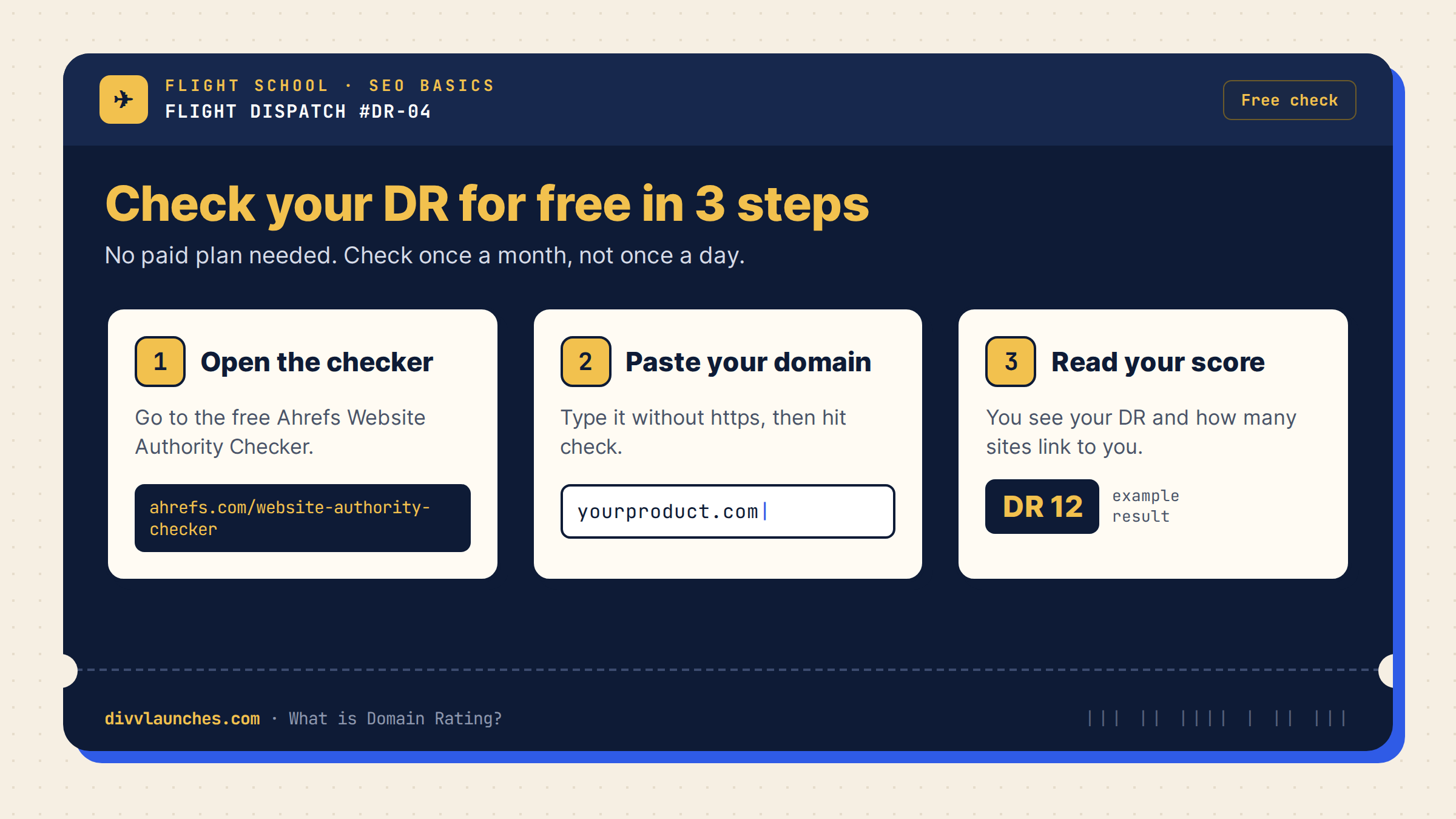
- 1Open the free Ahrefs Website Authority Checker.
- 2Paste your domain, for example yourproduct.com, without the https part.
- 3Hit check. You will see your DR plus how many sites link to you.
Want more detail on your own site? Ahrefs Webmaster Tools is free if you verify that you own the domain. It shows your backlinks and basic site health over time.
Tip: check your DR once a month, not once a day. It moves slowly, and staring at it daily will only stress you out.
How to grow your DR the healthy way
The goal is not a higher number. The goal is more real sites linking to you, and DR follows along. Here is where most indie makers get their first links.
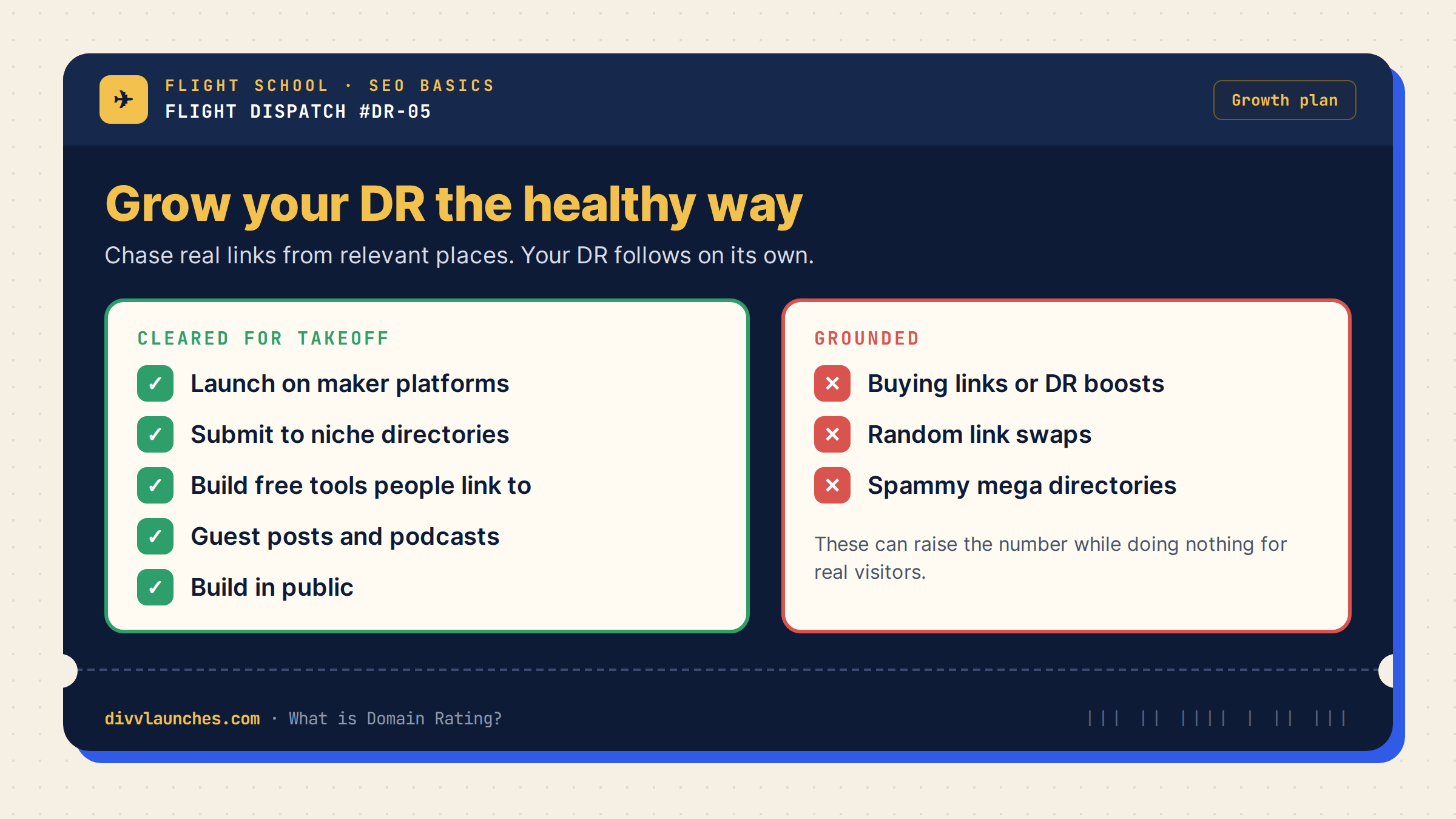
- 1Launch on maker platforms. Product launch sites and maker directories are the easiest first links you will ever get. Our list of 25 platforms every indie maker should know is a good place to start.
- 2Submit to relevant directories. Pick directories in your niche, not every directory on the internet. Ten relevant ones beat a hundred random ones.
- 3Build something people want to link to. A free tool, a template or an original data post gets links on its own. People link to useful things.
- 4Write guest posts or join podcasts. Share what you learned building your product. Most hosts link back to your site.
- 5Share your build in public. Posts on X, LinkedIn and Reddit are mostly nofollow, but they get you noticed. Bloggers and newsletter writers often find products there and link to them later.
What to avoid:
- Buying links or "DR boost" packages
- Link exchanges with random sites you have nothing in common with
- Spammy directories that list thousands of unrelated sites on one page
These can raise your DR on paper while doing nothing for real visitors, and some can get your site in trouble with Google.
Common DR myths
"Higher DR means more traffic." Not always. Plenty of high DR sites get almost no search traffic, and some low DR sites get a lot because they answer the right questions.
"Only high DR links are worth getting." A relevant link from a small, focused site can help more than one from a giant site that links to everyone.
"Google ranks sites by DR." Google does not use DR at all. It is a tool's estimate, not Google's.
"My DR dropped, so I did something wrong." DR is relative. It can dip when other sites grow, when a site that linked to you disappears, or when Ahrefs updates its data.
"A DR 50 directory will fix my SEO." One link is one link. Steady, varied links over months matter far more than any single one.
Quick recap
- DR is an Ahrefs score from 0 to 100 that measures how strong your backlinks are.
- It is relative, link based only, and not used by Google.
- Every new site starts at 0, and that is fine.
- Focus on real links from relevant places, and your DR will climb on its own.
Ready to get your first real links? Book your launch on DivvLaunches and put your product in front of makers and early adopters. New to links in general? Start with our backlink beginner guide.
Notes for publishing (remove before posting)
- Category: SEO & Backlinks. Tags: #SEO #Backlinks #DomainRating
- Meta title: What is Domain Rating (DR)? A Beginner Guide for New Sites
- Meta description: Learn what Ahrefs Domain Rating means, how it is calculated, whether Google uses it, and how to grow it the right way as a new maker.
- Slug: /blog/what-is-domain-rating
- Internal links: the backlink guide and 25 platforms links currently point to /blog. Swap in their real slugs.
- Open question: are DivvLaunches listings dofollow? If yes, say so in step 1 of "How to grow your DR". It is a strong selling point.
- Images: all five are placed in this draft as 2400 x 1350 PNGs. Use the hero image (DR-01) as the blog card and OG image too.
Sources:

Divv Saxena
PILOT IN CHIEFFounder & Flight Director
Guiding indie hackers and startup founders through takeoff, daily community upvoting, and verified directory distribution on DivvLaunches.
Ready to launch your product to early adopters?
Join the daily flight schedule on DivvLaunches. Up to 10 products take off each day at 00:00 UTC with real-time upvoting and permanent podium awards.
CONTROL TOWER RADAR
More Dispatches from Flight School
Pre-flight manuals, launch day blueprints, and founder growth telemetry.
