What is a backlink beginner guide
FLIGHT SCHOOL · BEGINNER GUIDE

Divv Pilot
Founder & Flight Director • September 28, 2026
FLIGHT SCHOOL · BEGINNER GUIDE
Backlinks, explained for people who just shipped their first product
What a backlink is, why everyone keeps telling you to get them, and the one term you actually need to know.
By Divv Saxena · DivvLaunches · 6 minute read
You built something. You put it online. Then someone in a founder group said, "Nice, now go get some backlinks."
And you nodded, because that is what you do, and then you quietly searched for what a backlink is.
This guide is for that moment. No jargon, no SEO theory, just the handful of things a new maker needs to understand before spending a single hour or dollar on this.
What a backlink actually is
A backlink is a link on someone else's website that points to yours.
That is the whole definition. If a startup directory lists your product and includes a link to your homepage, that is a backlink. If a blogger mentions your tool and links to it, that is a backlink. If your friend adds you to their "tools I use" page, same thing.
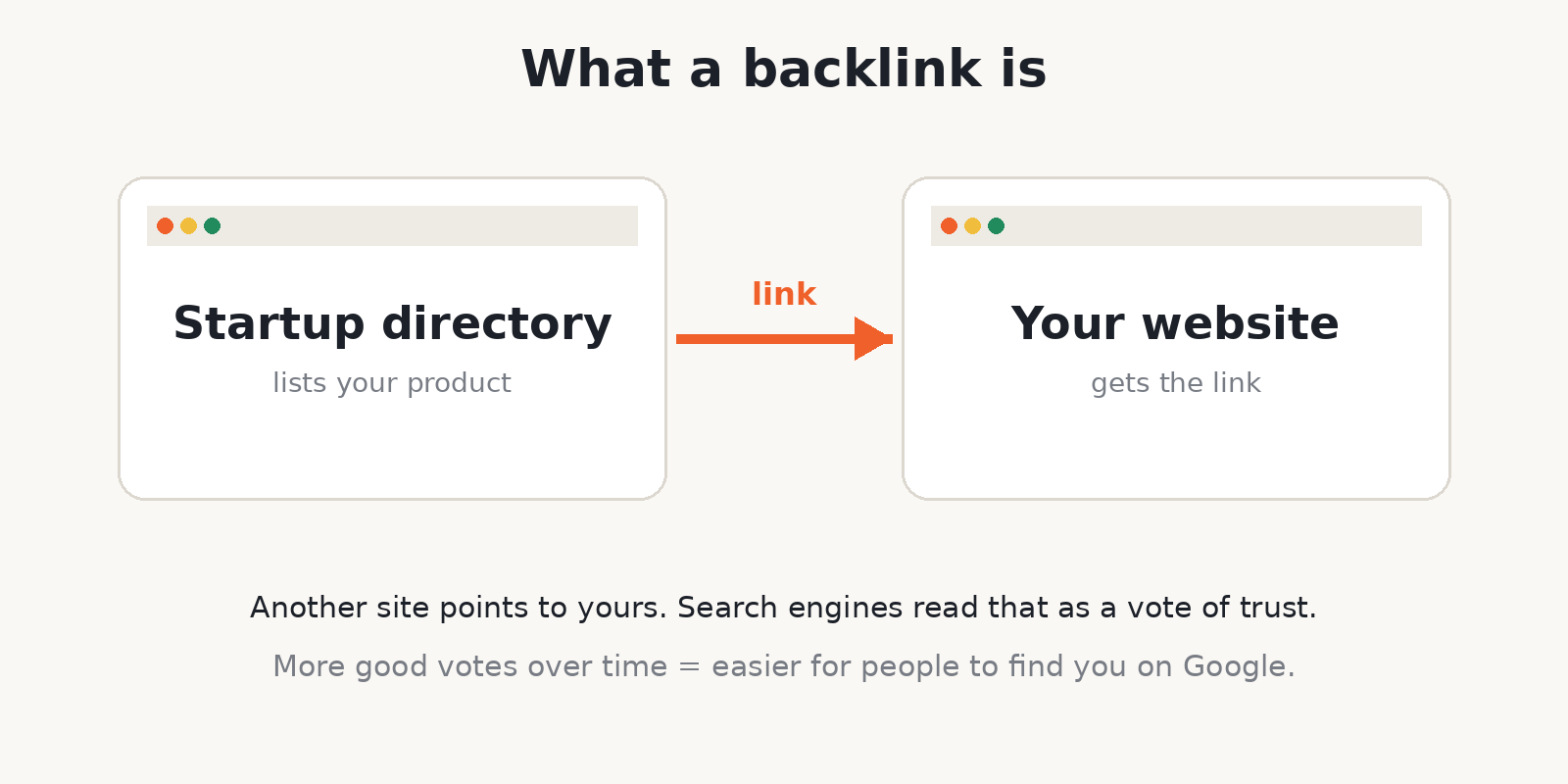
A backlink is simply another site pointing to yours.
The word sounds technical because it comes from the search engine world. Google sees the web as a giant map of links. When it finds a lot of sites linking to yours, it treats that as a signal that people find your site worth pointing at.
Why anyone cares
Search engines have a hard problem. Millions of pages claim to be the best invoice tool, the best habit tracker, the best whatever. They need some way to decide which ones to show first.
One of the signals they use is links. A link from another site works a bit like a vote of confidence. A site with many good votes tends to show up higher in search results than a site with none.
That is why makers care. Backlinks are one of the few things you can actively go and get in your first weeks, before you have much content or any brand. They help Google trust a brand new domain a little faster.
Three honest caveats before you get excited:
- Not all votes are equal. A link from a well known site counts for far more than a link from a site nobody visits.
- They are slow. Backlinks help over months, not days.
- They cannot rescue a bad product. Links get people to your page. What happens after that is on you.
The one term you need: dofollow vs nofollow
This is the part that trips most beginners up, so here it is in plain language.
Every link on the web can carry a small hidden tag that tells search engines whether to count it. A dofollow link says "yes, count this." A nofollow link says "this is a link, but do not treat it as a vote."
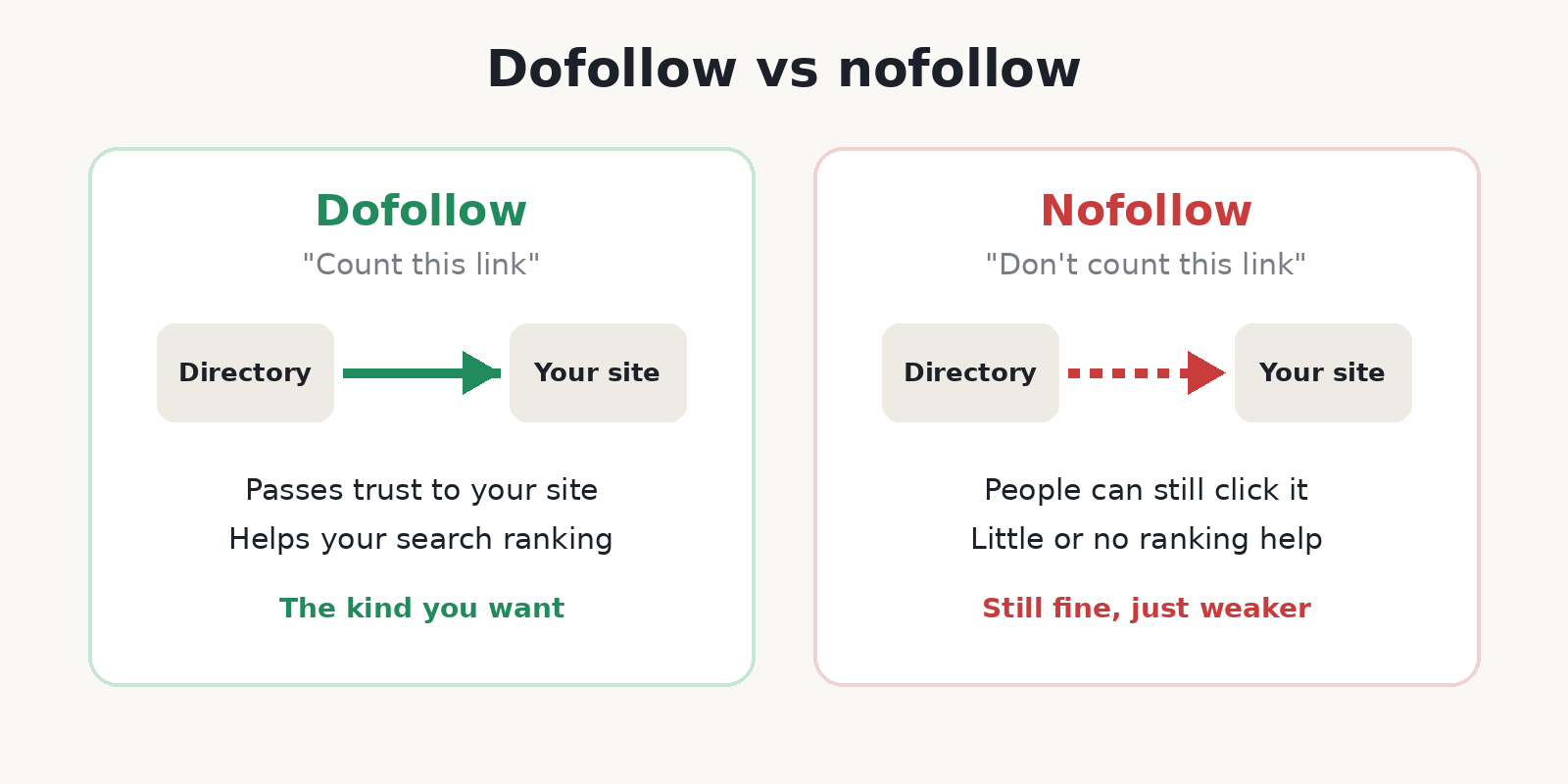
Both links work for humans. Only one of them helps your ranking.
A few things worth knowing:
- Dofollow is the default. If a site does nothing special, the link is dofollow.
- Big platforms like Reddit, Twitter and most comment sections mark links as nofollow, because otherwise they would be flooded with spam.
- A nofollow link is not useless. People can still click it and find you. It just does not move your search ranking much.
- When a directory says it offers "dofollow links," it is telling you the listing will count as a vote. That is why makers look for it.
You do not need to check this yourself for every site. Most directory lists, including the one on DivvLaunches, tell you which links are dofollow up front.
What "DR" means, and why makers obsess over it
You will see "DR 32" or "DR 50+" thrown around. DR stands for Domain Rating. It is a score from 0 to 100, invented by an SEO tool called Ahrefs, that estimates how strong a website's backlinks are.
A brand new site starts at 0. A site like Wikipedia sits near 100. Most indie products and small directories live somewhere between 10 and 50.
The score matters for one practical reason: a dofollow link from a DR 60 site gives you more of a boost than a link from a DR 8 site. So when you are choosing where to spend time, higher DR directories are usually the better use of it.
Do not chase the number for its own sake. Nobody buys your product because your DR went up. It is a rough indicator, useful for prioritising, and that is all.
Where new makers actually get backlinks
You do not need a PR agency. Most early links for indie products come from a few places:
- Launch platforms. Sites like DivvLaunches, Product Hunt and similar. You get a permanent product page with a link back to you.
- Startup directories. Curated lists of tools, sorted by category. Each listing is a page about your product with a link.
- Your own profiles. GitHub, LinkedIn, X, Dev.to and similar. Some are nofollow, but they still help people find you.
- Other makers. Friends who link to you from their blogs or tool lists. Underrated and free.
- Content people want to link to. A useful comparison, a free tool, a good write up. This takes longest and pays off the most.
The badge trade, explained
Many directories and launch platforms, DivvLaunches included, ask you to place a small "Featured on" badge on your website in exchange for a free listing.
Here is the deal being offered. They give you a page and a dofollow link. You give them a link back from your site. Both sides get a backlink. Nobody pays.
Is it worth it? For a new site with no links at all, usually yes. The badge sits in your footer, costs nothing, and the link you get in return is one you would otherwise have to pay for. If you would rather keep your site badge free, most platforms offer a paid option instead. Both are fair choices.
What to realistically expect
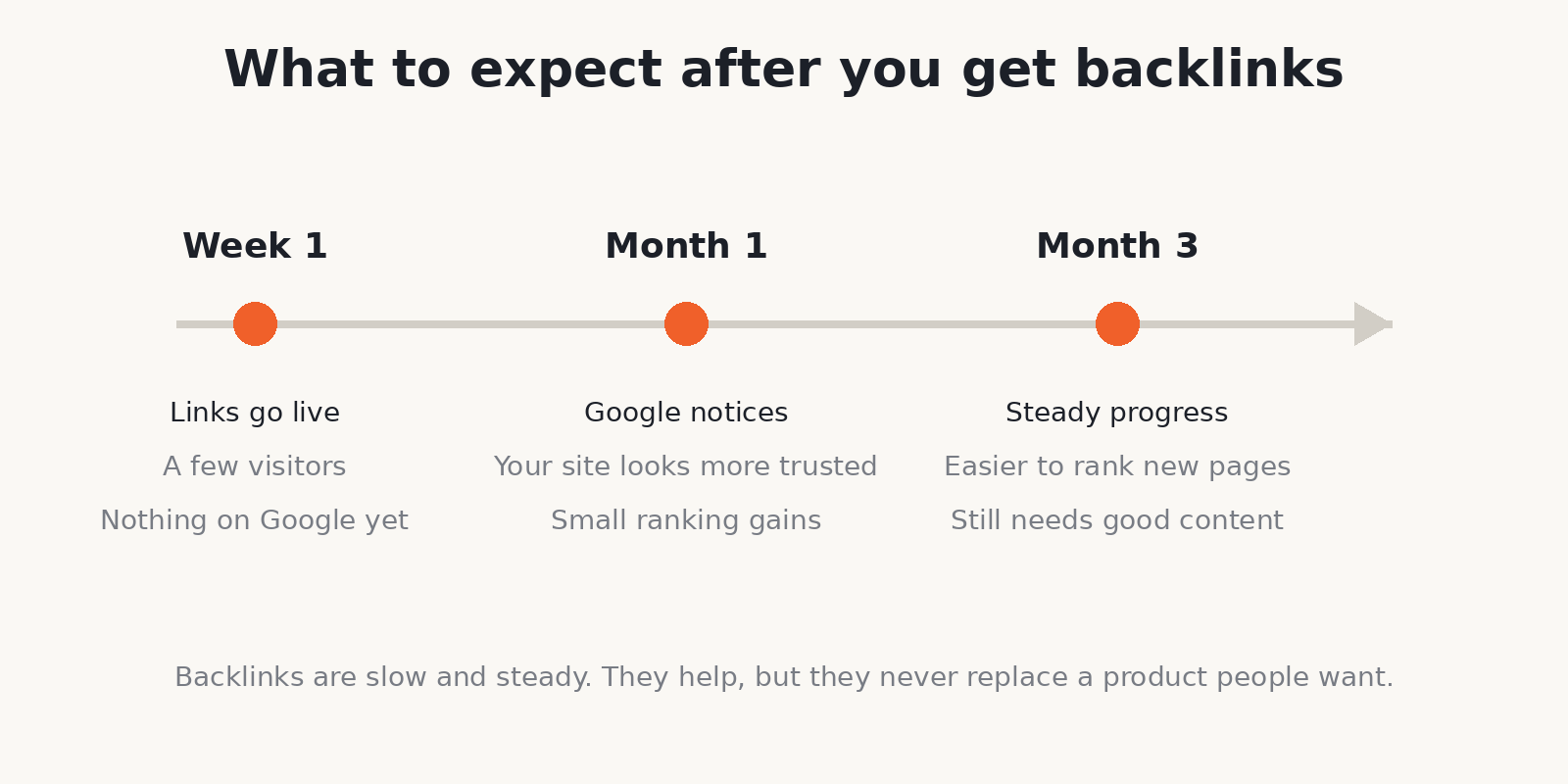
The timeline most new makers see, roughly.
If you submit your product to ten decent directories this week, here is roughly how it goes:
- Week 1. Listings go live one by one. You might see a handful of visitors from each. Google has not noticed anything yet.
- Month 1. Google has crawled the links. Your site starts to look a little more established. Pages you publish now get indexed faster.
- Month 3. The links have settled in. Ranking for your own product name is easy. Ranking for competitive keywords still depends on having good content.
If you were hoping backlinks would send a flood of customers, adjust that now. They are groundwork, not a growth channel. The traffic from directories themselves is small. The value is in what they do for your search visibility over time.
A simple first week plan
- 1Write your product details once: name, a one line tagline under 100 characters, a short description, a logo, and two screenshots. Save them in a doc. You will reuse them everywhere.
- 2Launch on one platform first so you have a permanent page and a badge to place.
- 3Submit to five to ten directories. Prioritise the ones marked dofollow and with a DR above 20.
- 4Keep a spreadsheet with the directory name, date submitted, and whether it is live. Approvals take days to weeks.
- 5Then stop, and go back to building. Check the sheet once a week.
That is the entire beginner version. Everything past this point is optimisation, and you can worry about it once you have something people actually use.
Want the full list?
DivvLaunches publishes the complete list of directories we submit to, with the DR and dofollow status of each one, at divvlaunches.com/directories. If you would rather not fill 74 forms by hand, we also do it for you.

Divv Pilot
PILOT IN CHIEFFounder & Flight Director
Guiding indie hackers and startup founders through takeoff, daily community upvoting, and verified directory distribution on DivvLaunches.
Ready to launch your product to early adopters?
Join the daily flight schedule on DivvLaunches. Up to 10 products take off each day at 00:00 UTC with real-time upvoting and permanent podium awards.