What is GEO? How to Get Recommended by ChatGPT | DivvLaunches
Oct 5, 2026 · @Divv Learn what GEO is and how to get your product recommended by ChatGPT, Claude and Perplexity. Simple explanations, visuals and a free 10 minute test.

Divv Saxena
Founder & Flight Director • October 5, 2026
Oct 5, 2026 · @Divv
Your next customer might never Google you
Picture this. Someone opens ChatGPT and types: "What's a good free tool to make invoices?"
ChatGPT replies with three names and a short reason for each. The person picks one and moves on. There is no page two. There are no ten blue links to scroll through. If your product is not one of those three names, that person never even learns you exist.
This is happening more and more. People ask ChatGPT, Claude, Gemini and Perplexity for recommendations the same way they used to ask Google. Getting your product into those answers has a name: GEO.
In this guide, I'll explain GEO the way you'd explain it to a 12 year old, with simple pictures along the way. By the end, you'll be able to explain it to a friend, and you'll have a 10 minute test to check if AI tools recommend your product today.
GEO in one sentence
GEO (Generative Engine Optimization) is the work of making AI tools understand, trust and mention your product when people ask them for recommendations.
Let's break the name down, one word at a time:
- Generative means the tool writes a fresh answer for you, instead of showing a list of websites.
- Engine is the tool doing the answering, like ChatGPT, Claude, Gemini or Perplexity.
- Optimization means making small improvements so you show up more often.
So GEO is simply: making improvements so answer-writing tools mention you. That's it. Everything else in this guide is just the "how".
The name comes from a 2023 research paper by a team that included researchers from Princeton and IIT Delhi. They tested what makes a website more likely to show up inside AI answers, and we'll use some of what they found later on.
The simple picture: a library vs a well read friend
Imagine you want a good book to read.
The old way is the library catalog. You type "mystery" and it hands you a stack of 200 cards. You flip through them, read the backs, and decide for yourself. That's Google. It gives you a list, and you do the work.
The new way is asking a friend who has read almost every book in the library. You say "I want a good mystery" and they say "Read these two. The first is short and fun, the second is a classic." That's ChatGPT. It doesn't give you a list. It gives you an answer.
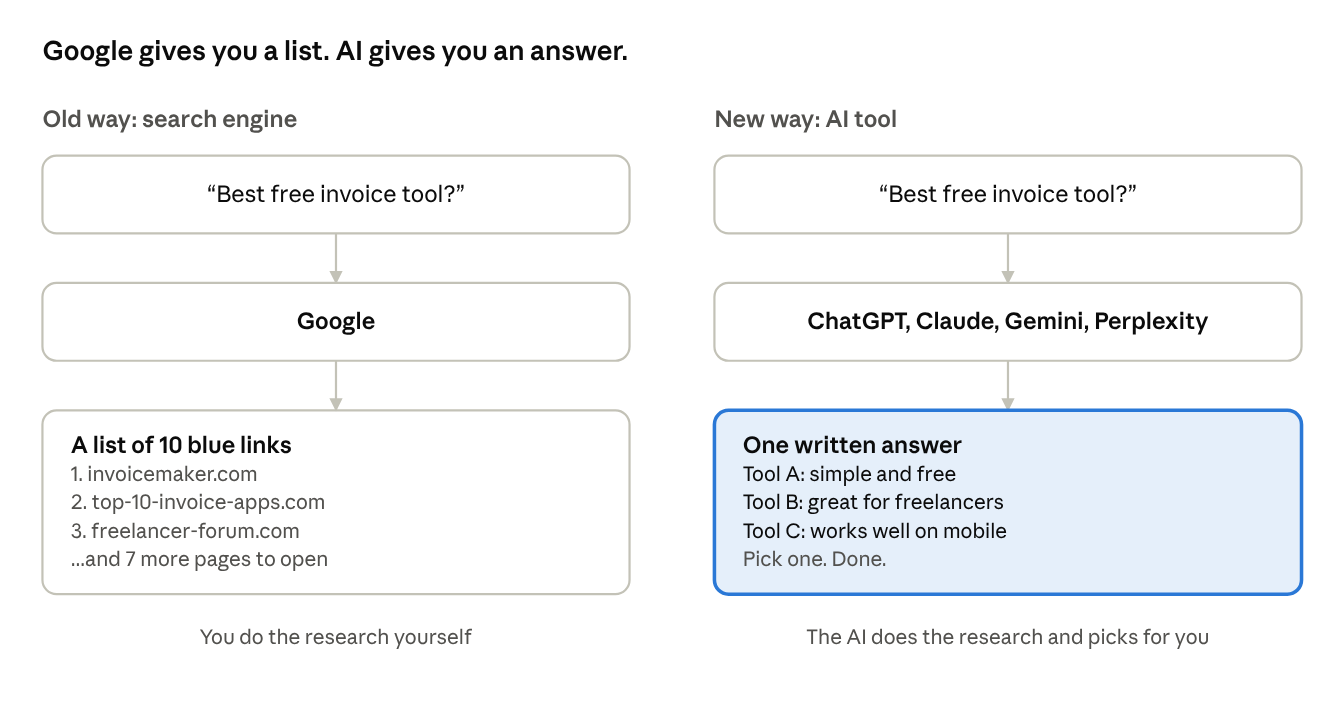
Search engine vs AI tool · same question, two very different results
Here's the key idea: your friend can only recommend books they have heard about, and they recommend the ones that people keep talking about in a good way. GEO is making sure the well read friend has heard of your product, understands what it does, and has heard good things about it.
How does an AI tool decide what to recommend?
AI tools get their answers from two places. Some use one, many use both.
Path 1: Memory. Before an AI tool is released, it reads a huge part of the internet: blog posts, Reddit threads, reviews, directories, help docs. This is called training. It's like your well read friend remembering everything they read. But that memory has a cutoff date, so anything newer is missing until the next update.
Path 2: Live search. When you ask a question, many AI tools also search the web right then, read the top pages they find, and write an answer from them. This is like your friend quickly looking something up before replying.
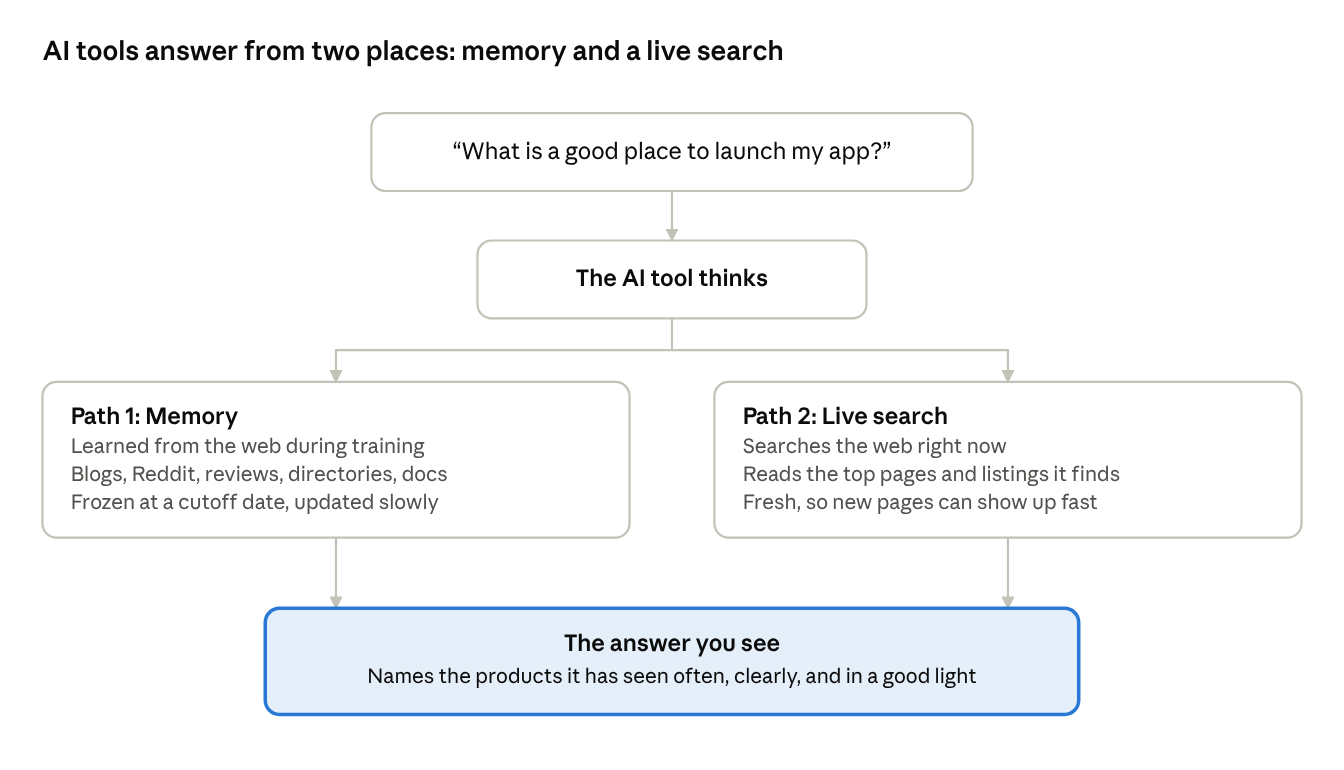
Where an AI answer comes from · two paths, one answer
Notice what both paths have in common. The AI can only recommend what it has read about. And it trusts things that show up in many places, explained clearly, by people who seem to know what they're talking about.
So if your product is only mentioned on your own website, the AI has heard exactly one voice saying you're great: yours. That's not very convincing, to a person or to an AI.
SEO vs GEO: what's the difference?
SEO gets your page ranked in a list. GEO gets your product mentioned in an answer. They're cousins, not enemies.
- SEO | GEO
- Where you show up | Google's list of links | Inside the answer ChatGPT, Claude or Perplexity writes
- What winning looks like | Ranking on page one | Being one of the few names the AI mentions
- What gets the click | Your title and description in the results | The reason the AI gives for recommending you
- Who you need to convince | Google's ranking system | The AI, by being talked about well across the web
- Biggest helpers | Keywords, backlinks, fast pages | Clear explanations, mentions on trusted sites, real reviews, facts and numbers
One important thing: good SEO feeds good GEO. When an AI tool does a live search, it usually reads the pages that already rank well. So everything you learned in our backlink guide still counts. GEO just adds a few new habits on top.
Five things that actually help
Remember the well read friend. Everything below is just a way of making sure they hear about you more often, from more people, in clearer words.
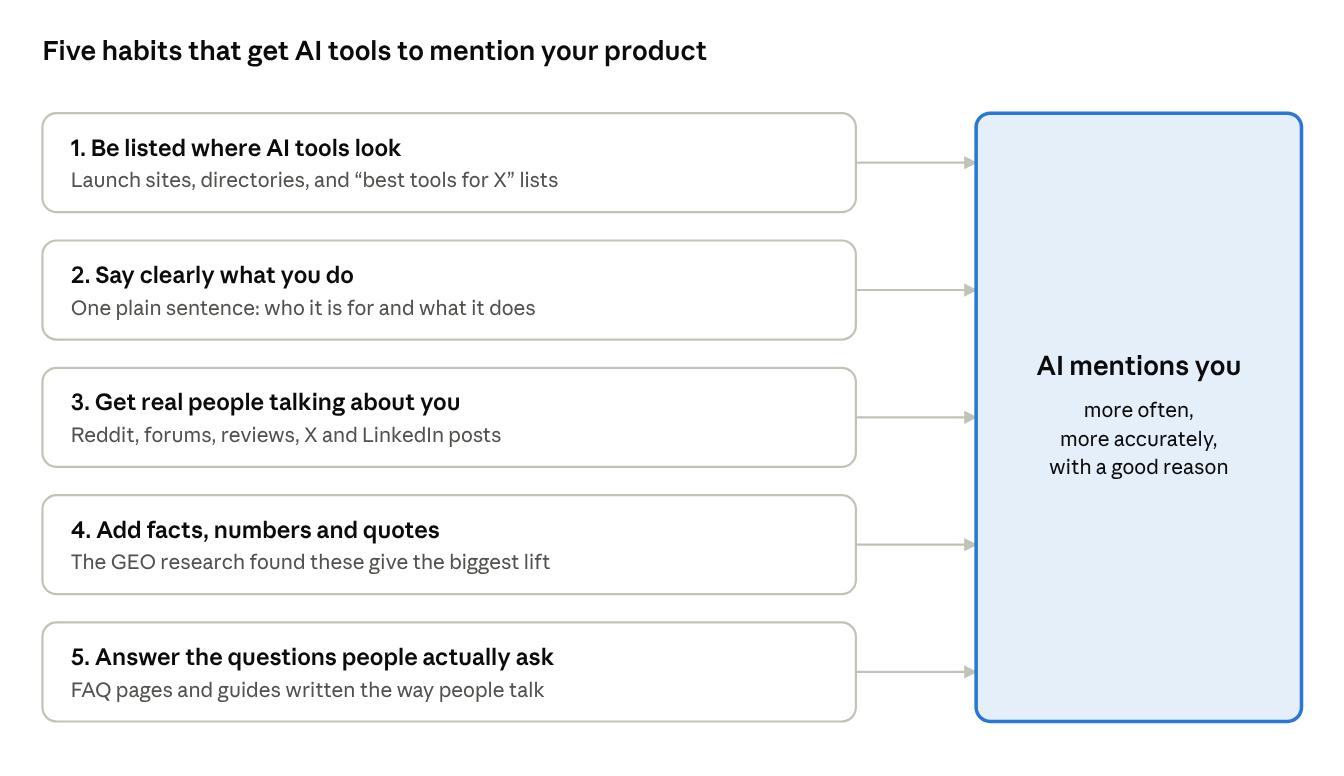
Five GEO habits · each one feeds the same goal
1. Be listed where AI tools look. When someone asks "what are good tools for X", AI tools lean on pages that already list tools for X: launch platforms, directories, comparison posts and "best of" lists. Every quality listing is one more voice saying "this product exists and does this". Our 25 platforms guide is a good place to start picking where to list.
2. Say clearly what you do. AI tools repeat what they understand. If your homepage says "We reimagine the future of productivity", the AI has nothing to repeat. Compare:
- Vague: "A smarter way to work."
- Clear: "A free invoice app for freelancers in the US that sends invoices in one tap."
Use that same clear sentence everywhere: your site, your listings, your social bios. Repetition helps the AI connect your name to your use case.
3. Get real people talking about you. AI tools trust what many different people say more than what you say about yourself. A genuine Reddit thread, a review, a tweet from a happy user or a mention in someone's newsletter all count. Never fake these. Just make it easy for happy users to share, and show up helpfully in communities where your users hang out.
4. Add facts, numbers and quotes. This one comes straight from the original GEO research. The researchers tested nine ways of improving a page and found that adding statistics, quotes from credible people and citations to sources gave the biggest boost, up to 40% more visibility inside AI answers. So instead of "our app is fast", write "our app creates an invoice in under 10 seconds" (if it's true!).
5. Answer the questions people actually ask. People talk to AI tools in full questions: "what's the cheapest way to launch an app?", "is Product Hunt worth it for a small app?" Write pages, FAQs and blog posts that answer those exact questions in plain words. When the AI goes looking for an answer, your page is a perfect match.
Common GEO myths (and the truth)
Myth: "GEO replaces SEO." Truth: GEO sits on top of SEO. AI tools that search the web mostly read pages that already rank, so you still need both.
Myth: "Stuff your page with keywords and the AI will pick you." Truth: the GEO researchers tested this too, and keyword stuffing barely helped. AI tools care about clear, useful information, not repeated words.
Myth: "Only big brands get recommended." Truth: big brands win broad questions like "best project management tool". Small products often win specific ones like "best invoice app for freelance designers in the US". Pick a clear niche and own it.
Myth: "Do it once and you're done." Truth: an AI tool's memory only updates when a new version is trained, which can take months. Live search changes faster, but it still needs pages and mentions to find. Think of GEO as a habit, not a one time task.
Myth: "Everyone sees the same answer." Truth: answers change with the exact wording, the tool, and sometimes from one try to the next. That's why the test below asks you to try several questions in several tools.
Try it yourself: the 10 minute GEO test
The best way to understand GEO is to see it in action with your own product. Grab a coffee and do this:
- 1Write 5 questions your ideal user would ask. Write them the way a real person talks, not like keywords. For example: "What's a simple app to track my workouts?" or "Where can I launch my side project for free?"
- 2Ask each question in 3 AI tools. For example ChatGPT, Claude and Perplexity. Open a fresh chat each time.
- 3Write down what happened. Were you mentioned? Who was mentioned instead? What reason did the AI give for each pick?
- 4Study the winners. Search the products that keep showing up. Where are they listed? How do they describe themselves in one sentence? Who is talking about them?
- 5Pick one habit from this guide and work on it for a month. Then run the same test again and compare.
You can copy this simple table to track your results:
- Question | ChatGPT | Claude | Perplexity | Who got mentioned instead
- Question 1 | Yes / No | Yes / No | Yes / No
- Question 2 | Yes / No | Yes / No | Yes / No
- Question 3 | Yes / No | Yes / No | Yes / No
Don't worry if you get "No" everywhere on your first try. Most new products do. The point is to know where you stand so you can watch it improve.
Can you explain GEO to a friend now?
Here's a simple test of whether something really clicked: can you explain it in 30 seconds without any jargon? Try saying this out loud:
"People now ask AI tools like ChatGPT what to use, and the AI gives them a few names instead of a list of links. The AI can only recommend products it has read about, and it trusts the ones that lots of people talk about clearly and positively. GEO is just making sure that's true for my product: being listed in the right places, explaining clearly what I do, getting real people to mention me, using real facts, and answering the questions people actually ask."
If you can say that, you understand GEO better than most people building products today.
Start small. Run the 10 minute test this week, fix your one sentence description, and get listed on a few trusted launch platforms. The well read friend is always listening. Make sure they hear about you.
Source: Aggarwal et al., GEO: Generative Engine Optimization, Princeton, Georgia Tech, Allen Institute for AI and IIT Delhi, published at KDD 2024.

Divv Saxena
PILOT IN CHIEFFounder & Flight Director
Guiding indie hackers and startup founders through takeoff, daily community upvoting, and verified directory distribution on DivvLaunches.
Ready to launch your product to early adopters?
Join the daily flight schedule on DivvLaunches. Up to 10 products take off each day at 00:00 UTC with real-time upvoting and permanent podium awards.
CONTROL TOWER RADAR
More Dispatches from Flight School
Pre-flight manuals, launch day blueprints, and founder growth telemetry.
Where to launch your product: 25 platforms every indie maker should know
You built the thing. Now where do you actually post it so people find it? Here are 25 places I'd launch on, split into big stages, maker platforms, directories and socials, plus a simple four week plan so your launch...
