How to Get Your First 100 Users Without Ads: A Playbook for Solo Founders
How to get your first 100 users without ads, from the team that runs a daily launch board: a four-rung ladder, a message example, one free-tool tactic, and what 56 recent launches showed us.

Divv Saxena
Founder & Flight Director •
Here is the honest answer to how to get your first 100 users without ads: you go and get them, by hand, a few at a time, from places where people already talk about the problem you solve. No channel hands you 100 strangers at once. Not Product Hunt, not Reddit, not a launch board. Ours included.
I run DivvLaunches, a daily launch board for indie makers. 108 products have launched on it so far, from 91 makers. I see what happens before and after a lot of launches, and the pattern is boring and consistent. The launches that get real clicks are the ones where the maker brought people with them. The board made that louder. It did not make it happen.
So this is the playbook I would follow if I had a new product, zero budget and zero users today.
First, decide what counts as a user
Pick a definition before you start counting, or you will fool yourself.
A visitor is not a user. An upvote is not a user. A waitlist email is barely a user. For this playbook, a user is someone who signed up and did the main thing your product does at least once. Exported the invoice. Ran the scan. Sent the first message.
Why 100? Because it is small enough to get by hand and big enough to show you a pattern. With 10 users you are guessing. With 100 you can see who sticks, who never comes back, and which channel the good ones came from.
The trap we see on our own launch board
Before the steps, one thing from our own data that changed how I think about this.
I went through every product that launched on DivvLaunches in the last 31 launch days (13 Oct to 12 Nov 2026). That is 56 launches. Then I sorted them by who they sell to.
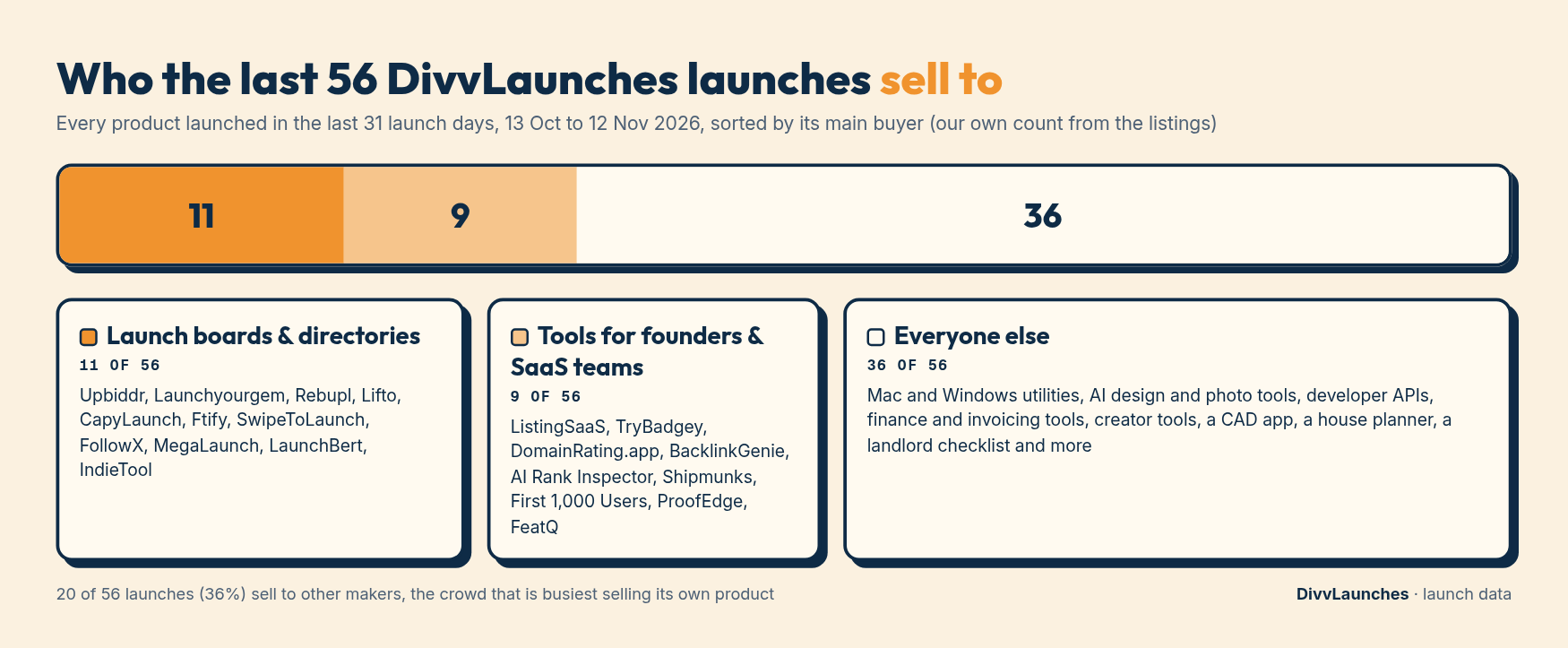
By my count, 11 of the 56 were launch boards or directories, and another 9 were tools sold to founders and SaaS teams: backlink tools, directory submission services, SEO checkers, social proof widgets. That is 20 of 56, more than a third, all trying to sell to the same small crowd of indie makers.
That crowd is the hardest place to find your first 100 users, because everyone in it is also selling. Post your launch board in a maker community and you get replies from people who want you to try their launch board.
If you build for founders, fine. I do too. But know that your first users will come from one-to-one conversations, not from one post in a maker community. And if your product is for landlords, video editors or students, stop hanging out where founders hang out. Your users are somewhere else.
How to get your first 100 users: the ladder
Here is the order I would go in. Each rung is a different source, and each one is harder to scale than the last, which is exactly why it works early.
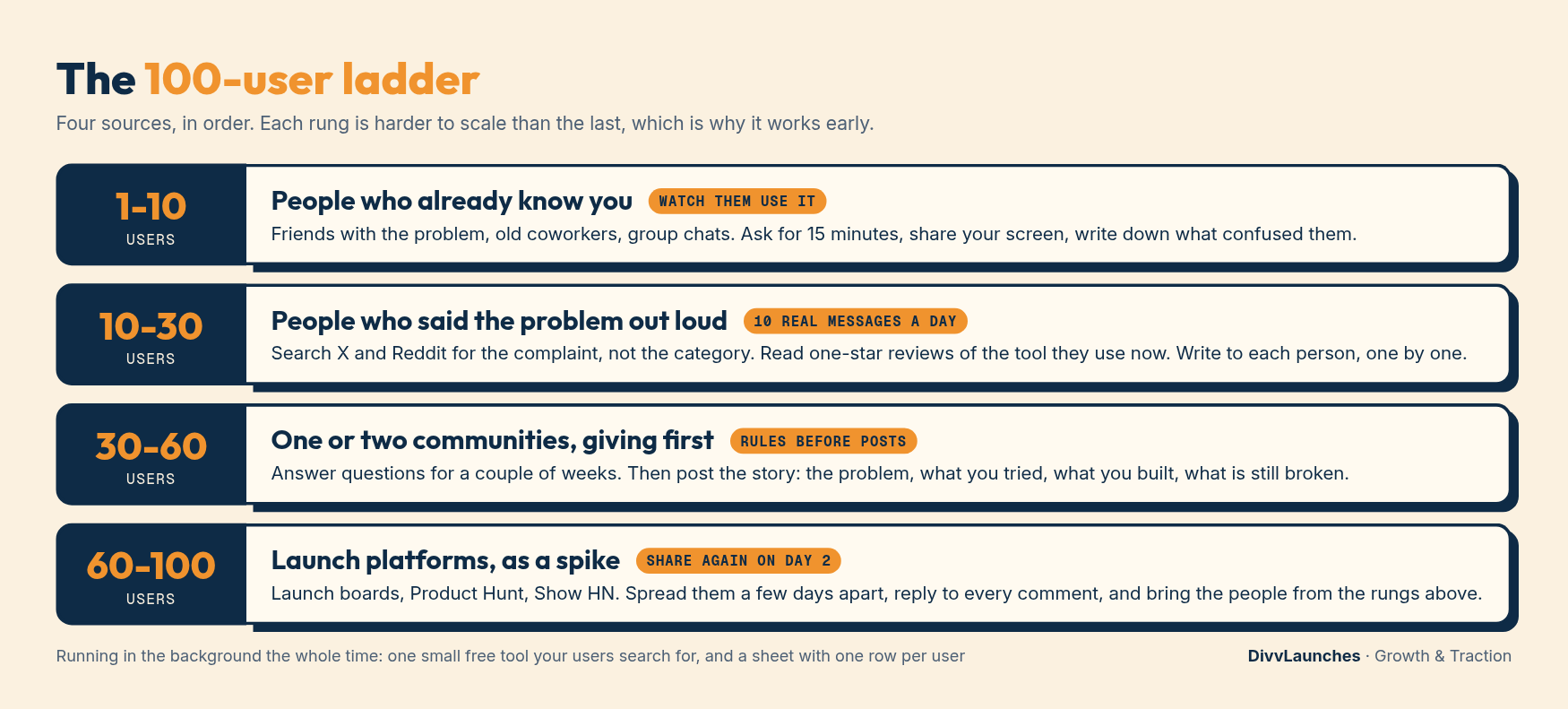
Users 1 to 10: people who already know you
Start with people who will reply to you. Friends who have the problem, old coworkers, people from your last job, people you have helped in a group chat.
Don't send a link and hope. Ask for 15 minutes, share your screen and watch them use it. Paul Graham calls this kind of work doing things that don't scale. In the same essay he describes the "Collison installation": when someone agreed to try Stripe, the founders said "give me your laptop" and set it up on the spot.
Your goal here is not the 10 signups. It is the list of things that confused them. Fix those before you go to strangers.
Users 10 to 30: people who said the problem out loud
People describe their problems in public all day. Your job is to find them.
- On X, search the complaint in plain words, not your category. "hate making invoices", not "invoicing software".
- On Reddit, search the problem inside the subreddits your users read, and sort by new.
- Read one-star reviews of the tool your users put up with today. Every complaint is a person you can write to.
Then write to them one by one. Short, specific, no pitch deck:
Saw your post about chasing late invoices every Friday. I built a small tool that sends the reminders for you. Want to try it free? If it's useless, tell me why and I'll fix it.
That message works because it proves you read their post. Copy-paste it to 200 people with the [name] swapped and it stops working. Keep the volume low enough that every message is real. Ten a day is plenty.
Users 30 to 60: one or two communities, giving first
Pick one or two communities where your users actually are and become a regular before you mention your product. Answer questions. Share what you learned. After a couple of weeks, people know your name, and a post about what you built reads like news from a regular, not an ad from a stranger.
Every community has its own rules about self-promotion, so read them first. Some subreddits only allow promo on a set day of the week. Indie Hackers is built for "here is what I made and what I learned" posts. Most Discord servers have a single channel for showing your work.
The posts that do well share a story: the problem, what you tried, what you built, what is still broken. Ask for feedback and mean it.
Users 60 to 100: launch platforms, as a spike
Now launch. Not before. A launch is a megaphone, and you want people already standing near you when you use it.
It also helps to be honest about what each platform can do in 2026. Product Hunt is the clearest example. According to Product Hunt Pulse, a third-party tracker of every launch, the share of launches that get featured on the homepage fell from 36% in 2022 to about 4% in 2026 so far. Every Debut, another launch site, summed up the Pulse numbers in its 9 Nov report and puts it at about 28 featured launches a day out of nearly 1,000 posted.
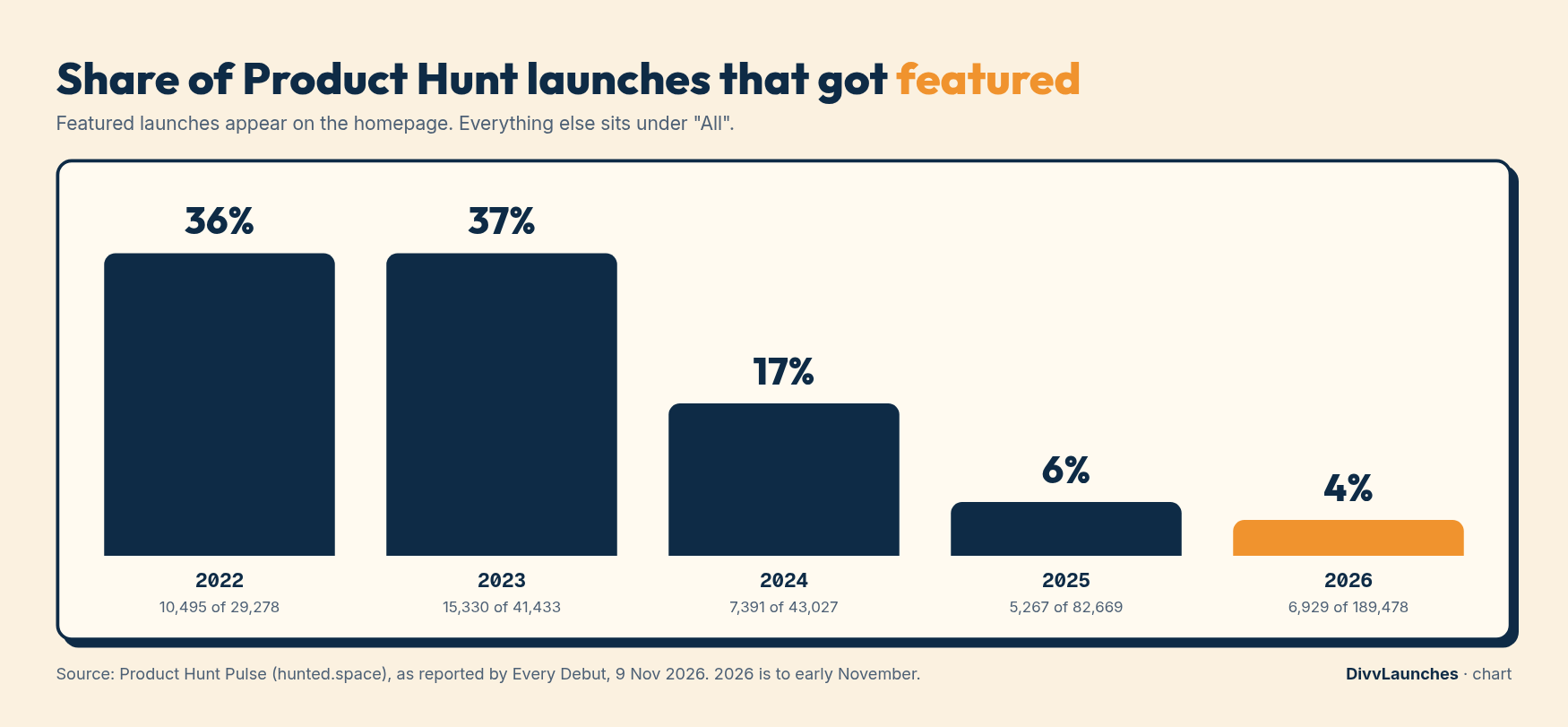
That doesn't make Product Hunt pointless. It means the launch itself won't find your users for you.
What we have seen on DivvLaunches matches this. When we studied 48 real launches on our board, the strongest pattern wasn't the listing at all. It was outside attention. Launches did best when the maker, or posts about the site, were bringing people in. Launch-day upvotes tracked clicks more closely than anything else we measured. We read that as a sign the founder showed up with an audience, not as upvotes causing anything.
Two other things from that study I'd act on:
- The day after launch beat launch day. Plan a second round of posts for day two. Thank people, share what you learned, post the link again.
- Your listing keeps getting found for weeks. A launch page is permanent. Write it for the person who finds it two months from now.
A quick word on links, because people ask. A free product page on DivvLaunches links to your site with a nofollow link, and First Class listings are marked sponsored. A launch listing is there for people to find and click, not to pass SEO value. If you want the details, read our post on dofollow vs nofollow links.
If you go to Hacker News, read the Show HN guidelines first. They say Show HN is for things people can actually try. Landing pages and sign-up pages are off topic. Users should be able to try it, ideally without signing up. You must not ask friends to upvote or comment. Respect that and HN is one of the best places to get blunt feedback.
For the order to run platforms in, our guide on how to launch a product has a four-week plan, and the 25 platforms list covers where. The product launch checklist has the 40 small steps people forget.
Build one free thing your users search for
This is a step many guides skip, and it's the one I like most for solo founders.
Build a small free tool, template or calculator that your future users would search for anyway. It does one job, needs no account, and lives on your domain next to your real product.
We see makers do this on our own board. ihateimg.cv launched on the free tier with "58 free image tools that run in your browser and never upload your files". Invoiceize is a free invoice generator. Kitwright launched a free Excel year-end checklist for DIY landlords. Shipmunks is free guides, calculators and templates for AI founders.
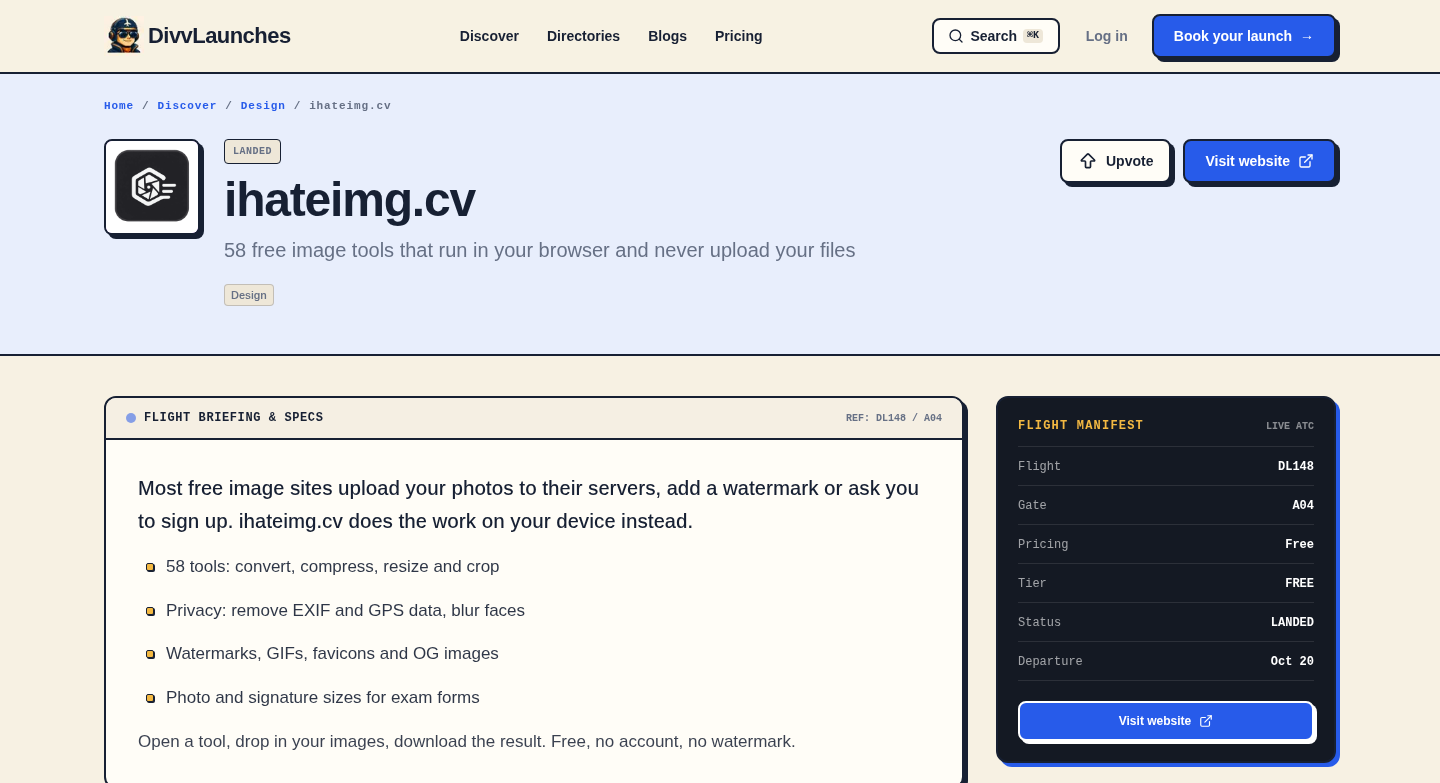
Notice how specific those are. "Year-end checklist for DIY landlords" is something a landlord types into Google in December. That's the point. A free tool keeps working while you sleep, and every person who uses it is someone who has your problem.
We do the same thing. DivvLaunches has free tools like an OG image generator and a launch readiness checker, because the people who use them are about to launch something.
Keep it small. One evening to one weekend. If it turns into a second product, you built the wrong free thing.
Track every user by hand
Under 100 users, a spreadsheet beats any analytics dashboard. One row per person.
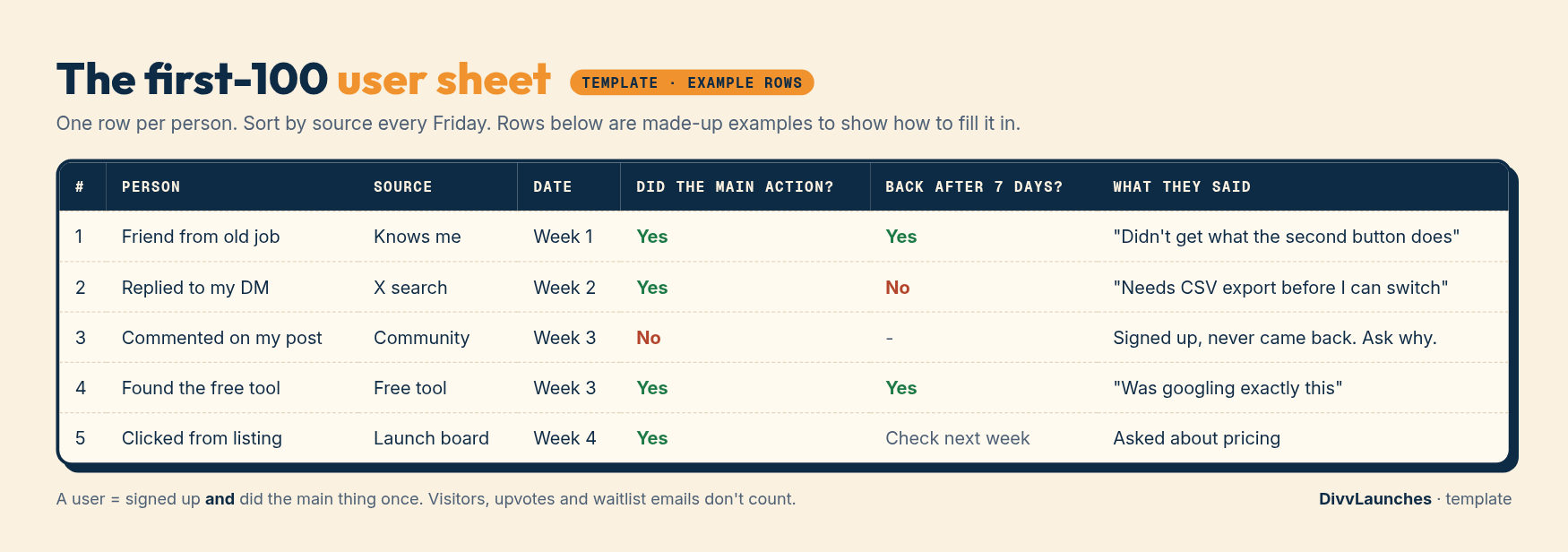
The columns that matter: where they came from, the date, whether they did the main action, whether they came back a week later, and what they said. Sort by source every Friday.
After 30 or 40 rows you will see it. One source sends people who stick. Another sends people who sign up and vanish. Do more of the first and stop the second. That decision is worth more than any growth tip, mine included.
Talk to everyone who comes back a second time. Ask what they were doing right before they signed up. Their words go straight into your tagline, your launch post and your next free tool.
What I would skip
Some things feel like progress and aren't.
Ads before you know who sticks. You'll pay to learn what 20 conversations would have told you for free.
Buying upvotes or joining vote rings. Hacker News tells you outright not to ask friends to upvote, it's obvious to anyone reading the comments, and fake votes don't sign up for anything.
Mass DMs. If the message would make sense sent to anyone, it will get ignored by everyone.
Launching everywhere on the same day. You can't reply to five comment sections at once, and replying is half of a launch. Spread platforms out over a few weeks.
Waiting until it's perfect. Your first users forgive rough edges if you fix what they report the same week. That's your edge over every big company: you can read every message and ship the fix tonight.
A four-week version you can start Monday
If you want it as a schedule:
Week 1. Write down your user definition. Get 5 to 10 people you know to use it while you watch. Fix what confused them.
Week 2. Ten real messages a day to people who posted the problem. Join one or two communities and start answering questions. Don't post your product yet.
Week 3. Build your small free tool. Post your story in the community you've been active in. Submit to a few directories so your product has pages people can find.
Week 4. Launch on one or two platforms, a few days apart. Share again the day after each launch. Check who made the podium on /winners and read their listings before you write yours. Log every new user in the sheet.
Then look at the sheet and do more of whatever sent the people who stuck.
When you get to week 4, launch on DivvLaunches: free launches get a permanent product page and a spot in the daily email, and you can bring your first users with you.

Divv Saxena
PILOT IN CHIEFFounder & Flight Director
Guiding indie hackers and startup founders through takeoff, daily community upvoting, and verified directory distribution on DivvLaunches.
Ready to launch your product to early adopters?
Join the daily flight schedule on DivvLaunches. Up to 10 products take off each day at 00:00 UTC with real-time upvoting and permanent podium awards.
CONTROL TOWER RADAR
More Dispatches from Flight School
Pre-flight manuals, launch day blueprints, and founder growth telemetry.
The Product Launch Checklist: 40 Steps Before, During and After Launch Day
A 40-step product launch checklist from the team that runs a daily launch board: the slow steps to start four weeks out, launch week, launch day, and the two weeks after.

Launched on DivvLaunches This Week: New Products, Nov 2 to 7
Fifteen products launched on DivvLaunches Nov 2-7. Five of them were rival launch boards. Full roundup with product links and maker handles.