Where to launch your product: 25 platforms every indie maker should know
You built the thing. Now where do you actually post it so people find it? Here are 25 places I'd launch on, split into big stages, maker platforms, directories and socials, plus a simple four week plan so your launch...

Divv Pilot
Founder & Flight Director • October 2, 2026
You built the thing. Now where do you actually post it so people find it? Here are 25 places I'd launch on, split into big stages, maker platforms, directories and socials, plus a simple four week plan so your launch isn't over in one day.
Where to launch your product: the four types of launch platforms
When I started building in public, I thought launching meant one thing. Post on Product Hunt, refresh the page all day, done.
That's not how it went. My first 40 days had basically zero traction. What actually started working was showing up in a lot of small places, again and again, instead of betting everything on one big day.
So this is the list I wish someone had handed me. No fluff. Just where to launch, what each place is good for, and how to not waste your time.
First, why launch in more than one place?
Because every launch platform does a different job for you. Some give you a big spike of visitors for a day. Some give you a few real users who actually give feedback. And some give you a backlink that keeps helping your Google ranking for years.
If you only launch on one big platform, you get the spike and then nothing. If you spread out, you get all three.
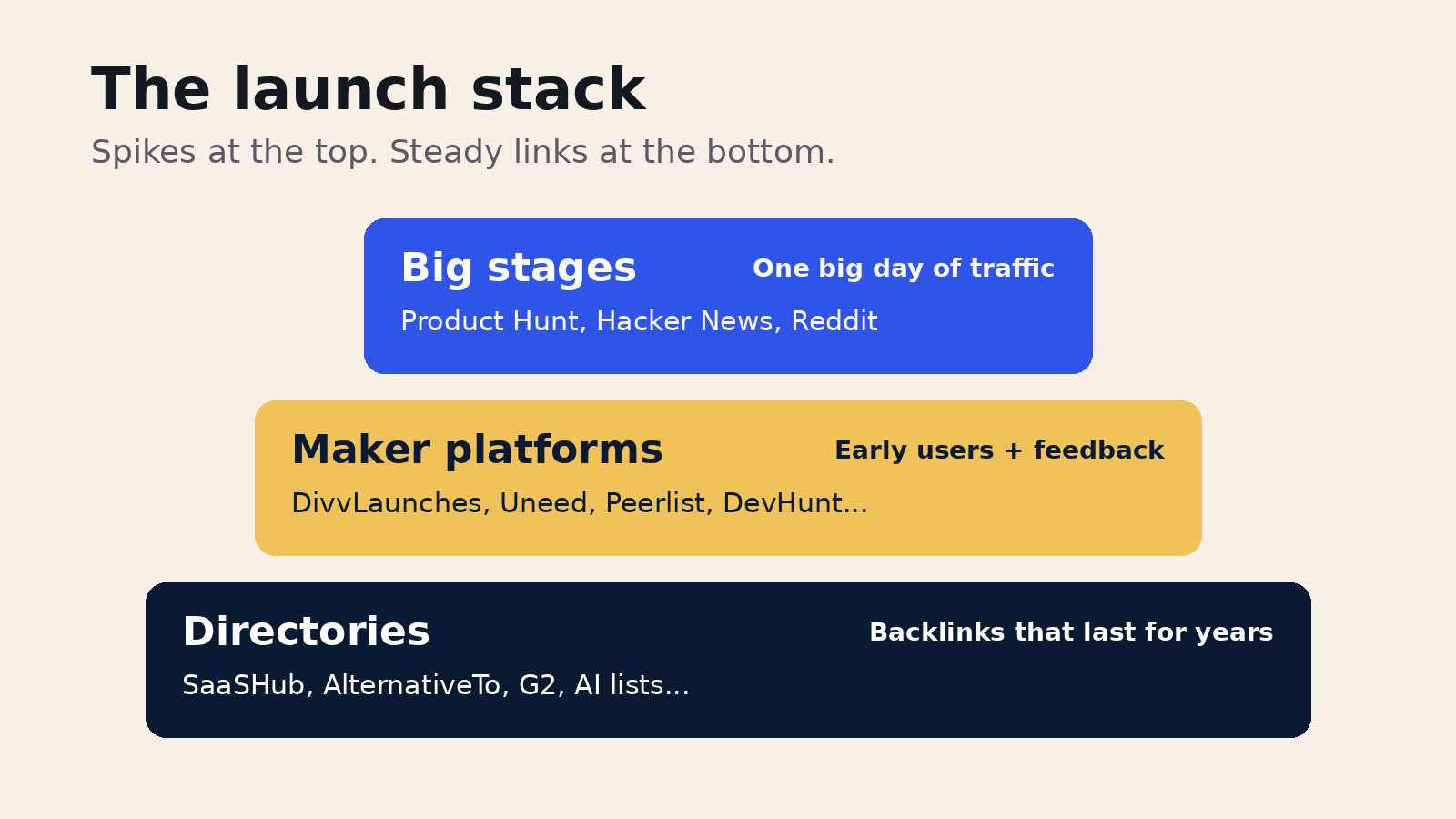
The launch stack: big stages for spikes, directories for lasting links
Quick note on backlinks: if you are new to them, read our beginner guide first, What is a backlink. Short version: a dofollow link from another site tells Google your site is worth trusting. A nofollow link still sends visitors but doesn't pass that SEO value. Both are useful, just for different reasons.
The big stages
These are the ones everybody talks about. Lots of eyeballs, lots of competition. Go here when your product is polished and you have time to be online all day replying to people.
Product Hunt. Still the biggest launch day in tech. Great if you have a network ready to support you on the day. Hard if you are launching cold with no audience, so don't make it your first launch.
Hacker News (Show HN). Post your product as a Show HN. The crowd is technical and honest, sometimes brutally. If it hits the front page, the traffic is huge. Write like a human, not a marketer, or it will flop.
Reddit. Subreddits like r/SideProject, r/indiehackers and r/alphaandbetausers are made for this. Read each subreddit's rules first. Share the story of why you built it, not just a link.
Indie Hackers. A community of people building exactly what you are building. Better for sharing your journey and numbers than for a one time launch post.
Maker launch platforms
These are smaller than Product Hunt, which is honestly the point. You won't get buried in the first hour, and the people browsing are other makers who actually try things.
DivvLaunches. Okay, this is ours, so I'm biased. It's a launch platform built for indie makers, with daily launches, a product directory and our Flight Log newsletter that goes out to subscribers. If you're reading this, you already know where the Book your launch button is.
Uneed. A clean daily launch platform with a friendly maker community. Good for getting early upvotes and a few first users.
Peerlist Launchpad. Peerlist is a professional network for builders, and its weekly Launchpad gets your product in front of developers and designers.
DevHunt. Made specifically for developer tools. If you built something for devs, launch here.
Microlaunch. Built for small products and side projects. Less pressure, longer launch window.
Fazier. Another daily launch platform for makers. Easy submission and a decent community.
BetaList. Best for products that aren't fully launched yet. Great for collecting early signups while you're still building.
TinyLaunch. Small launch platform focused on indie makers and tiny products.
Launching Next. A long running directory of new startups. Simple submission, nice for a steady link.
Nick Launches. A launch platform for indie products with its own newsletter and community. Another good spot to get your product in front of makers.
Directories that keep working for years
Directories are boring, and that's why most people skip them. But they don't disappear after 24 hours. People search them when they're looking for a tool, and a good listing keeps sending visitors and SEO value long after your launch week.
SaaSHub. A big software directory where people compare tools. Add your product and pick the right alternatives so you show up next to bigger names.
AlternativeTo. People search here for alternatives to popular apps. If your product replaces something well known, this one can send surprisingly good traffic.
Startup Stash. A curated directory of startup tools and resources.
G2. The big one for B2B software reviews. Worth it once you have a few happy users who can leave reviews.
Capterra. Similar to G2, popular with small businesses looking for software. Again, reviews are what make it work.
Crunchbase. Less about traffic, more about credibility. A complete company profile helps when investors, journalists or partners look you up.
There's An AI For That. If you built an AI tool, this is one of the biggest AI directories out there.
Futurepedia. Another large AI tools directory. Worth submitting to if your product uses AI in any way.
Toolify. AI tools directory with lots of categories, good for niche AI products.
Your own socials
This one gets ignored, but it's where your launch actually lives long term. Platforms come and go. Your audience stays.
X (Twitter). Build in public. Share the launch, then share the results. My monthly numbers posts get way more reach than any launch announcement ever did.
LinkedIn. Underrated for indie makers. Tell the story behind the product in plain words and tag the platforms you launched on.
How to check if a listing gives you a real backlink
Not every platform gives you a dofollow link, and this can change over time. So don't trust any list, including this one. Check it yourself. It takes 10 seconds.
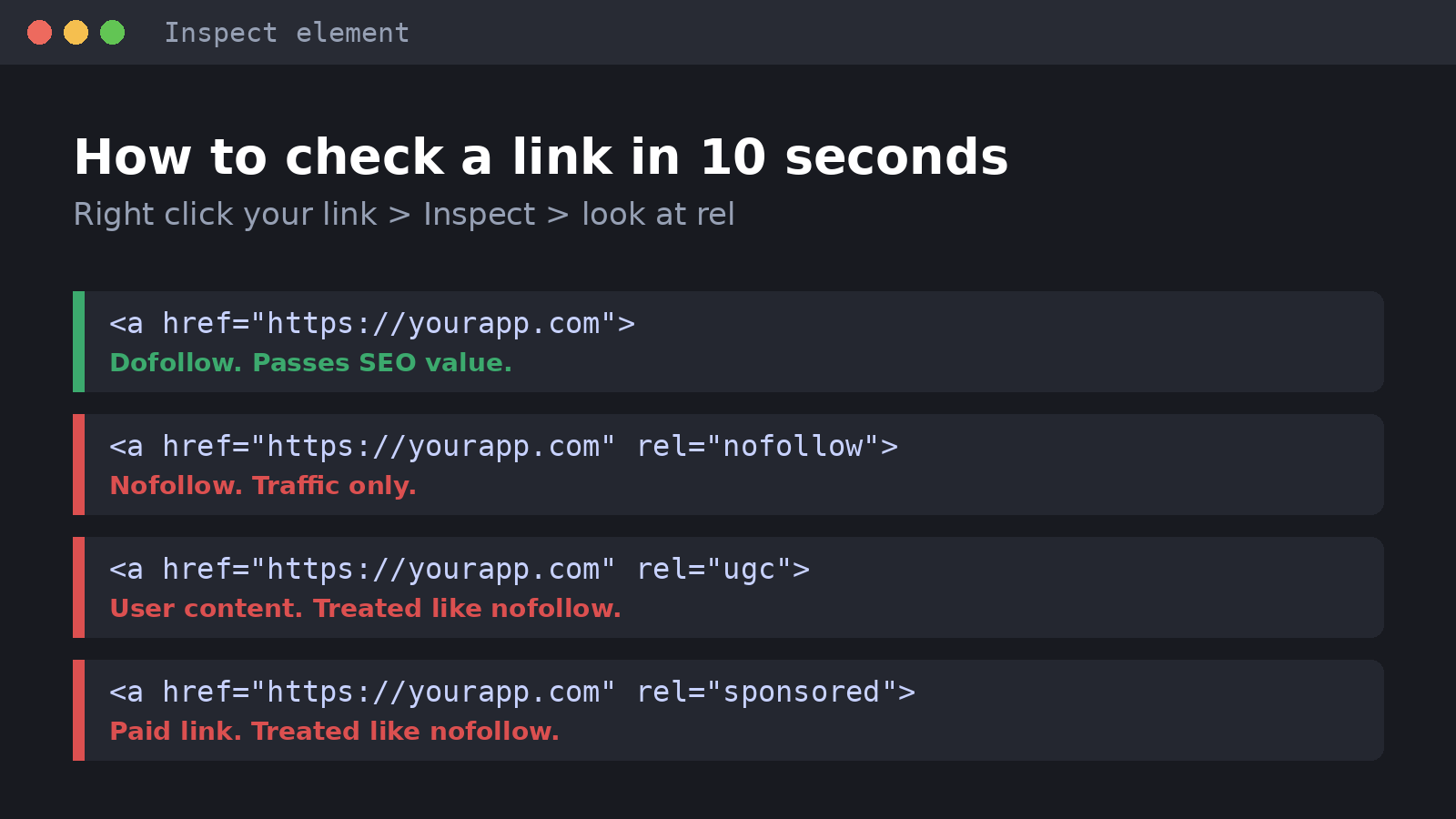
Right click your link, choose Inspect, and look at the rel attribute
- Open your live listing page.
- Right click on the link to your website and choose Inspect.
- Look at the code. If there's no rel or it doesn't say nofollow, ugc or sponsored, it's a dofollow link.
- If it says nofollow, ugc or sponsored, it's still worth having for traffic, it just won't pass SEO value.
Don't launch everywhere on the same day
This was my biggest mistake early on. I submitted everywhere in one afternoon, got one small bump, and then had nothing left to talk about.
Spread it out over a few weeks instead. Every new platform becomes a new reason to post on X and LinkedIn, and every post brings a few more people back to your product.
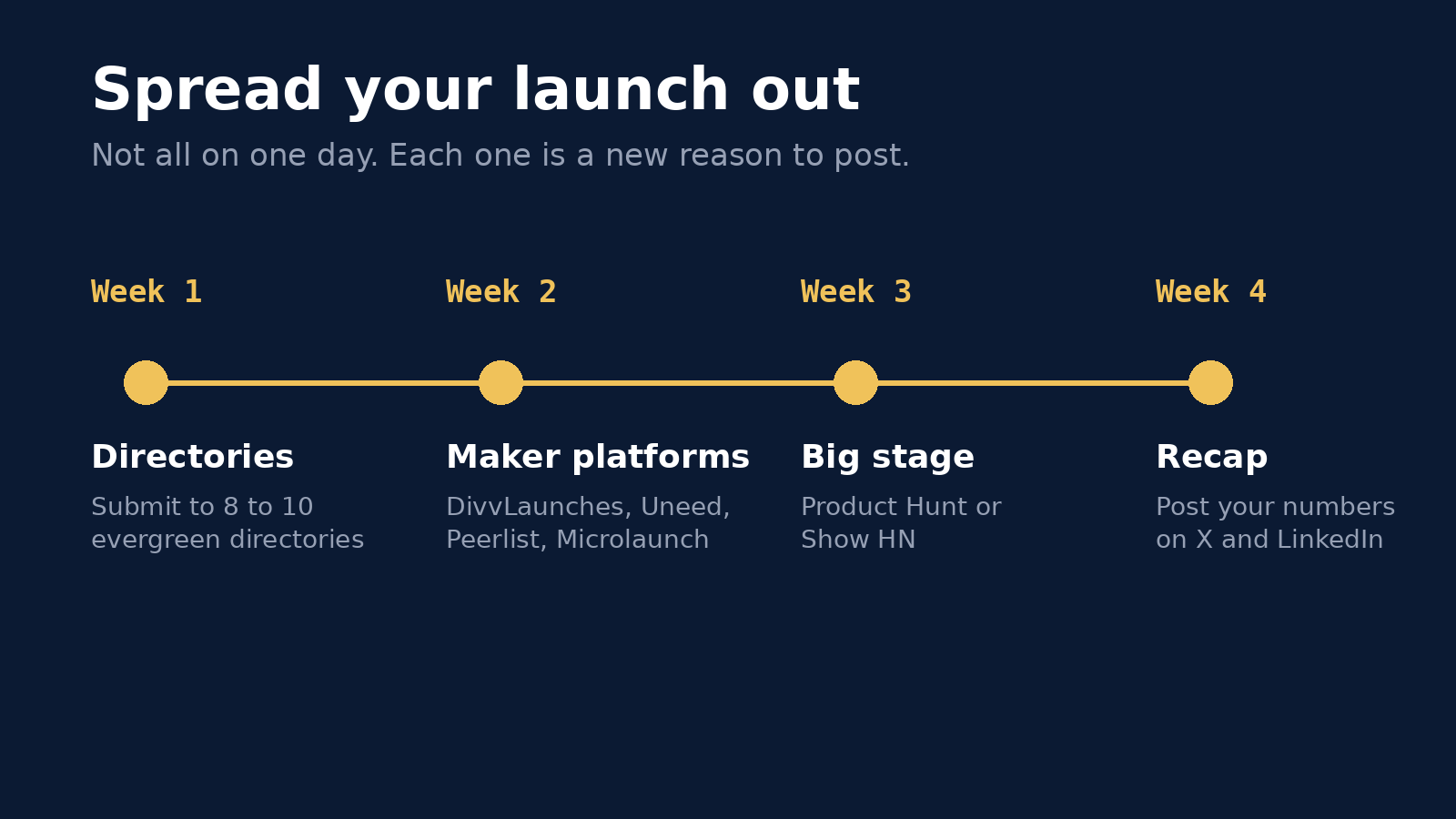
A simple four week launch plan
- Week 1: submit to 8 to 10 directories. They take time to approve anyway.
- Week 2: launch on the maker platforms. Reply to every comment.
- Week 3: go for the big stage, Product Hunt or Show HN, once you've fixed what the first users told you.
- Week 4: post a recap with real numbers. Visitors, signups, what worked, what flopped. People love this stuff.
Before you submit anywhere
Have these ready in one doc so every submission takes two minutes instead of twenty:
- A one line tagline that says what your product does, not how cool it is.
- A short description, around 2 to 3 sentences.
- A logo, 3 to 5 screenshots and if possible a short demo video.
- Your website link with UTM tags, so you know which platform actually sent people.
- A first comment or maker note explaining why you built it.
Wrapping up
You don't need to launch on all 25 this week. Pick five that fit your product, check what kind of links they give, and spread them out.
Launching isn't a single day. It's a habit. Keep showing up in small places and it adds up faster than you'd think.
And when you're ready for your next one, come launch with us on DivvLaunches. I'll see you on the runway.

Divv Pilot
PILOT IN CHIEFFounder & Flight Director
Guiding indie hackers and startup founders through takeoff, daily community upvoting, and verified directory distribution on DivvLaunches.
Ready to launch your product to early adopters?
Join the daily flight schedule on DivvLaunches. Up to 10 products take off each day at 00:00 UTC with real-time upvoting and permanent podium awards.
CONTROL TOWER RADAR
More Dispatches from Flight School
Pre-flight manuals, launch day blueprints, and founder growth telemetry.
What is a backlink beginner guide
FLIGHT SCHOOL · BEGINNER GUIDE
