How to Launch a Product in 2026: The Step-by-Step Guide for Indie Makers
A 4-week plan for launching a product in 2026: what to prepare, where to launch in what order, and what 48 real launches on DivvLaunches say actually gets clicks.

Divv Saxena
Founder & Flight Director •
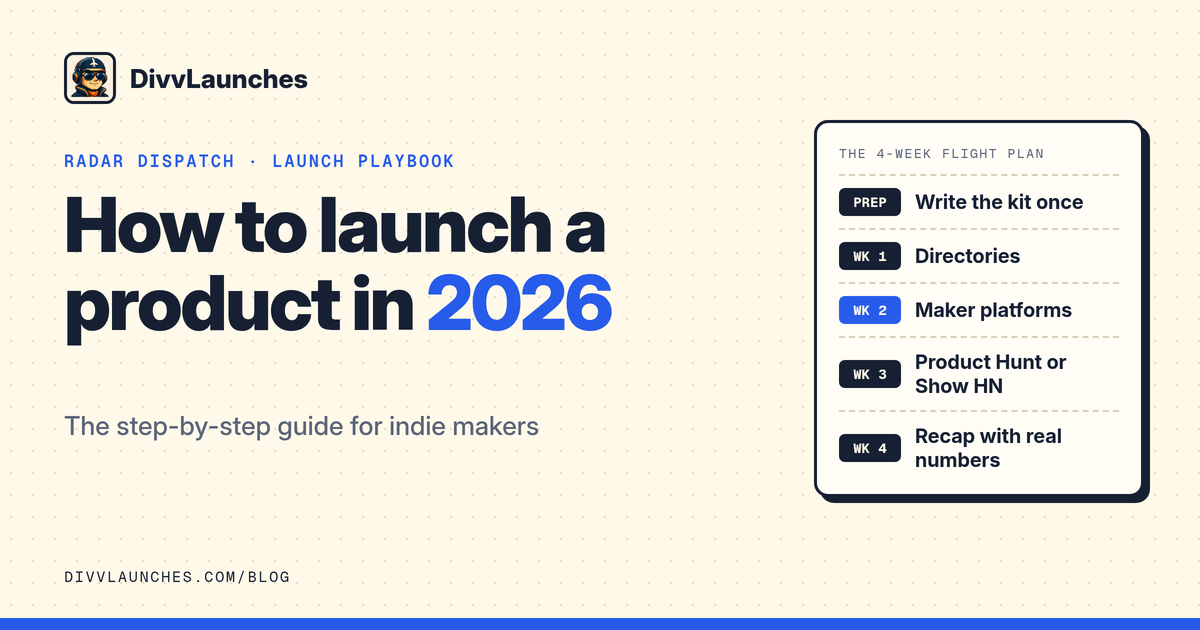
To launch a product in 2026, spread it over four weeks instead of betting on one day. Prepare your listing once, submit to directories in week one, launch on maker platforms in week two, take the big stage (Product Hunt or a Show HN) in week three, and post a recap with real numbers in week four. Share it again the day after every launch, because that's when most of the clicks show up.
That's the whole method. The rest of this guide is how to do each step, with what we've seen from running DivvLaunches, where 91 products from 77 makers have launched so far.
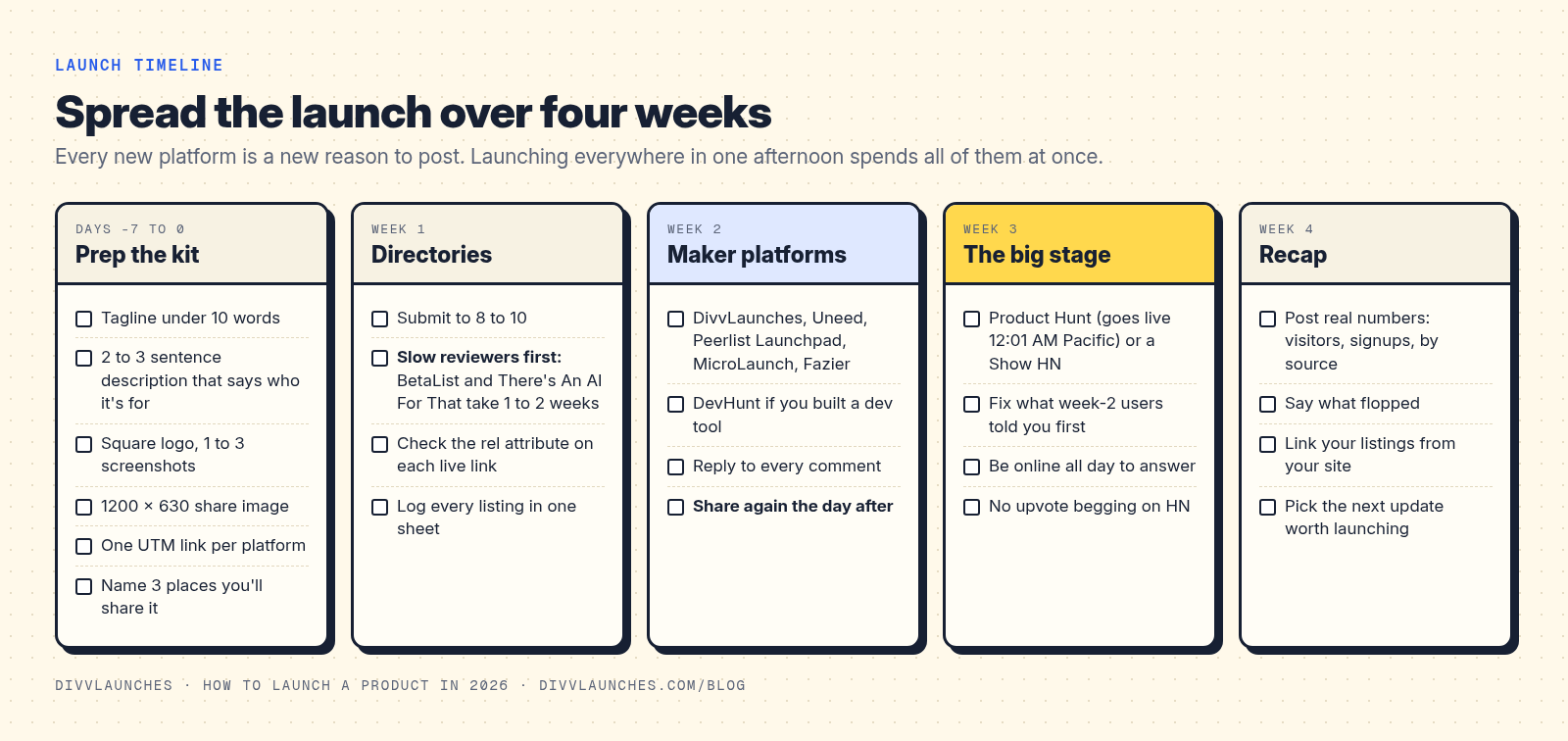
The 4-week launch plan. Every new platform is a new reason to post.
Why one big launch day doesn't work anymore
When I started building in public, I thought launching meant one thing: post on Product Hunt, refresh the page all day, done. My first 40 days had basically zero traction.
Our own data says the same thing. We tracked first-week clicks on 48 real launches on DivvLaunches. The median launch got 1 click. 19 of the 48 got none. The top 10 took 72% of all clicks.
The launches that did well had one thing in common, and it wasn't a better listing. The founder brought people with them. Launch-day upvotes tracked clicks more closely than anything else we measured, and upvotes mostly come from the founder's own network.
A launch platform amplifies attention. It can't create it from nothing. So the job isn't to find the one perfect platform. It's to show up in a lot of places, in a sensible order, and bring your people each time.
Step 1: Make it something a stranger can try in two minutes
Before you think about platforms, open your product in an incognito window and pretend you've never seen it. Can someone understand it and try it in two minutes?
Hacker News has the clearest rule on this. Its Show HN guidelines say a Show HN has to be something people can actually try, not a landing page or a sign-up page, and they ask you to make it easy to try "ideally without barriers such as signups or emails."
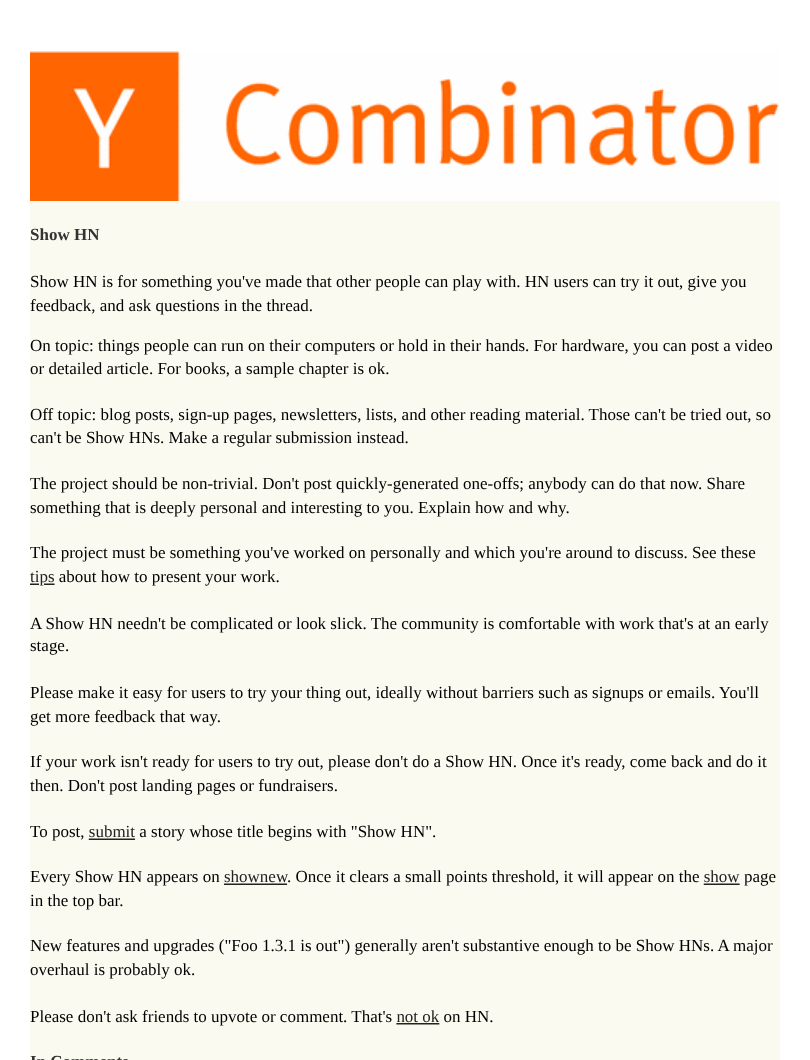
Hacker News' Show HN rules. Worth reading even if you never post there.
That's a good bar for every launch, not just HN. If your product needs a demo call, a waitlist or a credit card before anyone sees it working, most launch-day visitors will leave. Add a demo account, a free tier, or a sample file people can run without signing up.
Step 2: Write your launch kit once
Every platform asks for the same six things. Write them in one doc before you submit anywhere, so each submission takes two minutes instead of twenty.
- A tagline under 10 words. Say what it is and who it's for. In our study, the top 10 launches had a median tagline of 9 words and the bottom 10 had 18.
- A 2 to 3 sentence description. What it does, who it's for, and one number: a price, a time saved, a count.
- A square logo that still reads at 48 pixels.
- 1 to 3 screenshots. In our data, 1 screenshot and 3 screenshots got the same median clicks, so don't delay launch to make ten.
- A 1200 x 630 share image, so your link looks right on X, LinkedIn and Slack. Our free OG Image Generator makes one in your browser, and the Link Preview Checker shows how it'll look.
- A UTM link for each platform, like
yoursite.com/?utm_source=uneed, so you know which one sent signups and not just visitors.
The tagline is where most people slip. 60% of the taglines we studied were 110 characters or longer, against a 120-character cap, and launch cards cut them off mid-sentence. A tagline that ends in "Try it free and" looks unfinished.
Run your listing through our Launch Readiness Checker before you submit. It's the same code DivvLaunches uses to approve launches: 70 out of 100 with every required check passing. It works for any platform, and nothing you type leaves your browser.
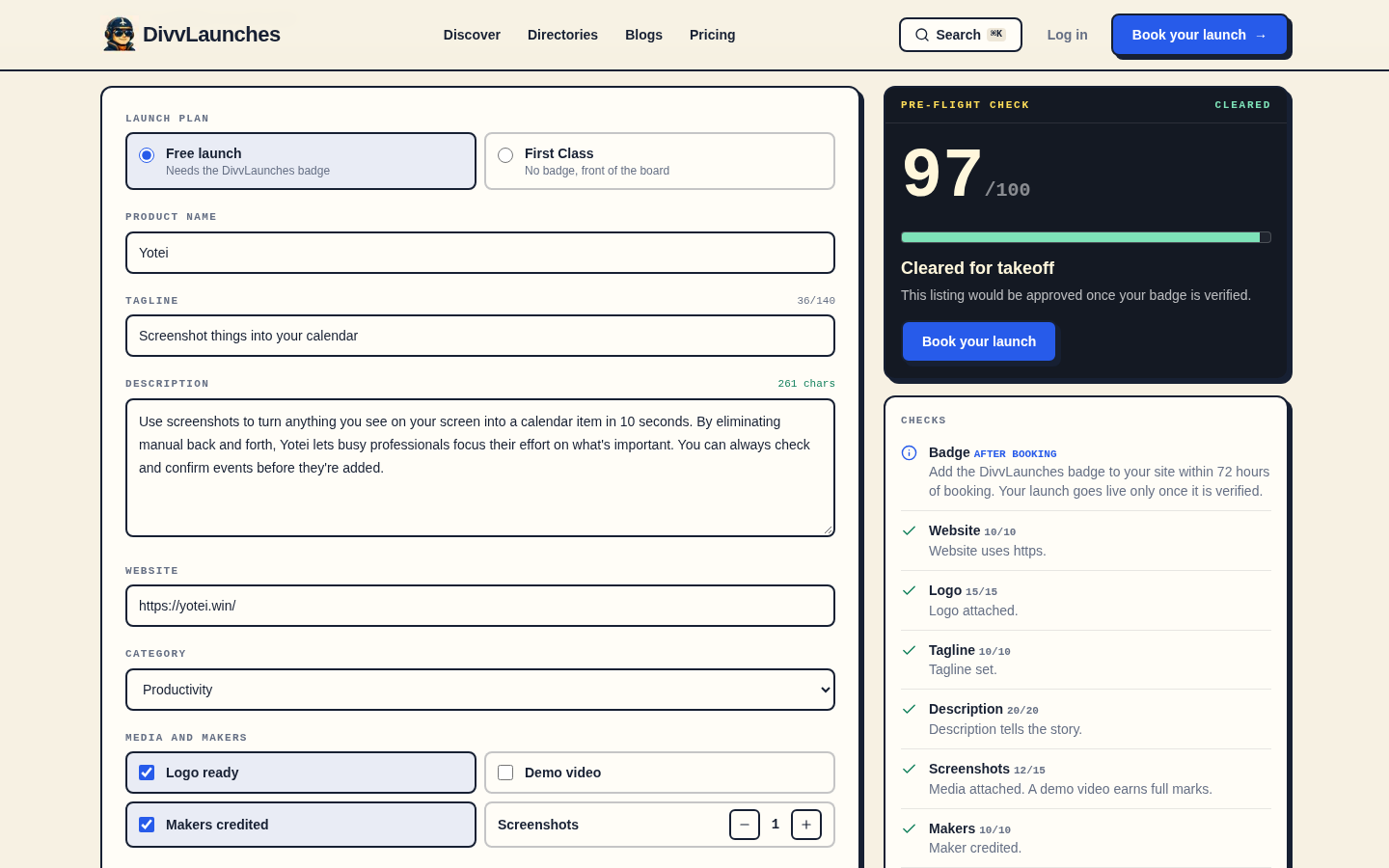
[Yotei's](https://www.divvlaunches.com/product/yotei) real listing scores 97. The one tip it got: say who the product is for.
Step 3: Decide where your people are before launch day
This is the step everyone skips, and the data says it matters most.
Write down three places you'll share the launch, by name. Not "social media". Something like: my X account, the r/SideProject subreddit, and the founder Slack group I'm in. If you have a newsletter, even a tiny one, that's one of them.
Then write the posts now, while you're calm. A short story of why you built it, one screenshot, and the link. On launch day you'll be busy replying to comments, and the posts you write in a rush always come out worse.
If you're starting with no audience at all, that's normal. Start posting what you're building on X or LinkedIn a few weeks before launch. You don't need a big following. You need a small group of people who've watched you build and want to see you ship.
Step 4: Week one, submit to directories
Directories are boring, and that's why most founders skip them. But a directory listing doesn't disappear after 24 hours. People search directories when they're looking for a tool, and a good listing keeps sending visitors long after launch week.
The trick is timing. Some directories review submissions in minutes, others take one to two weeks. Submit the slow ones first, so they go live around your main launch instead of a month later.
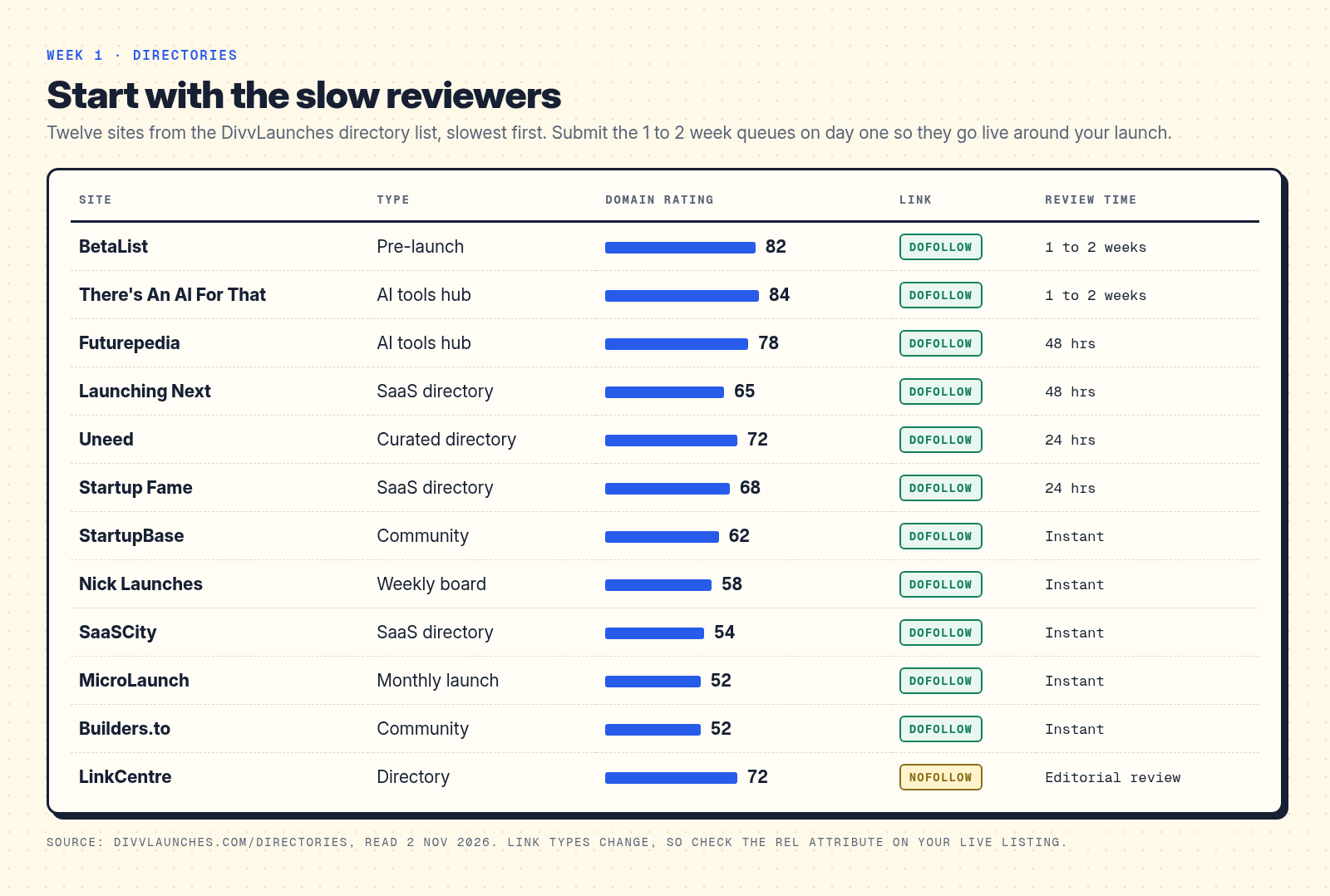
Twelve places to start, from our [directory list](https://www.divvlaunches.com/directories). Review times and link types as listed on 2 Nov 2026.
Submit to 8 to 10 in week one. Pick the ones that fit your product. There's An AI For That and Futurepedia only make sense for AI tools, and BetaList is built for products that are still pre-launch.
When each listing goes live, check the link yourself. Right-click the link to your site, choose Inspect, and look at the rel attribute. If it says nofollow, ugc or sponsored, the link still sends visitors but doesn't pass SEO value. Our beginner guide to backlinks explains the difference, and the post on Domain Rating explains what those DR numbers mean for a new site.
If you'd rather not do 74 forms by hand, our directory submissions service does it for you, starting at $49.99 for 25 directories.
Step 5: Week two, launch on maker platforms
Maker platforms are smaller than Product Hunt, and that's the point. You won't get buried in the first hour, and the people browsing are other makers who actually try things and leave comments.
Good ones to start with:
- DivvLaunches. Ours, so I'm biased. Daily launches, a permanent product page, and a spot in that day's launch email.
- Uneed. (how it compares) A daily launch platform with an active maker community.
- Peerlist Launchpad. (how it compares) A weekly launch in front of developers and designers.
- MicroLaunch. (how it compares) A longer launch window, so less pressure on one day.
- Fazier. (how it compares) Easy submission, decent community.
- DevHunt, if you built something for developers (how it compares).
You can launch on several of these. DivvLaunches and Product Hunt don't ask for an exclusive launch, and launching in more than one place is normal. Just space them a few days apart so each one gets your full attention, and so you have something new to post about each time. The comparison links above cover how each platform's free route, voting and links work, and our Product Hunt alternatives page puts the main options side by side.
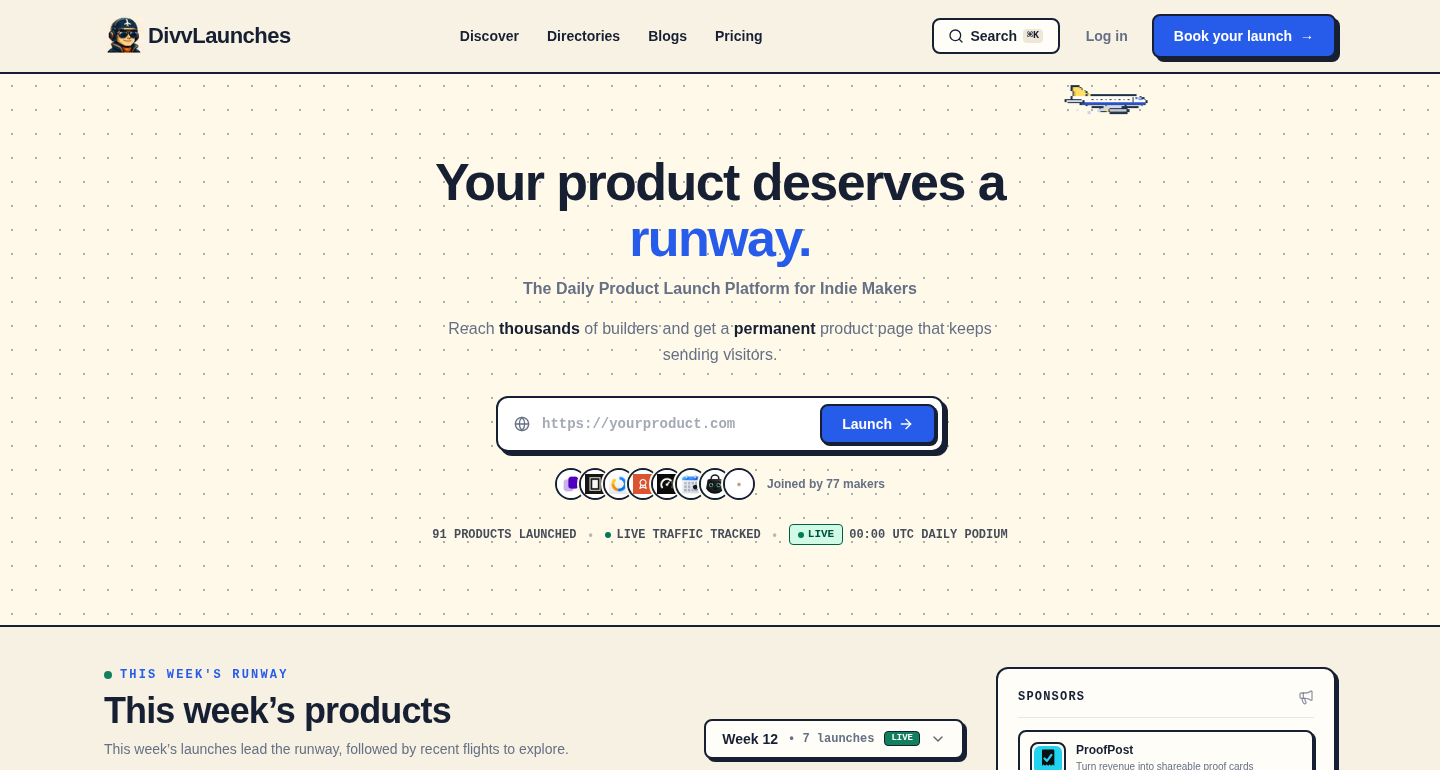
The DivvLaunches homepage. Each day's launches go to the top of the board.
Plan the day after, not just launch day
Here's the most useful thing our data showed. Launch day brought only 14% of first-week clicks. The next day brought 31%, more than twice as many.
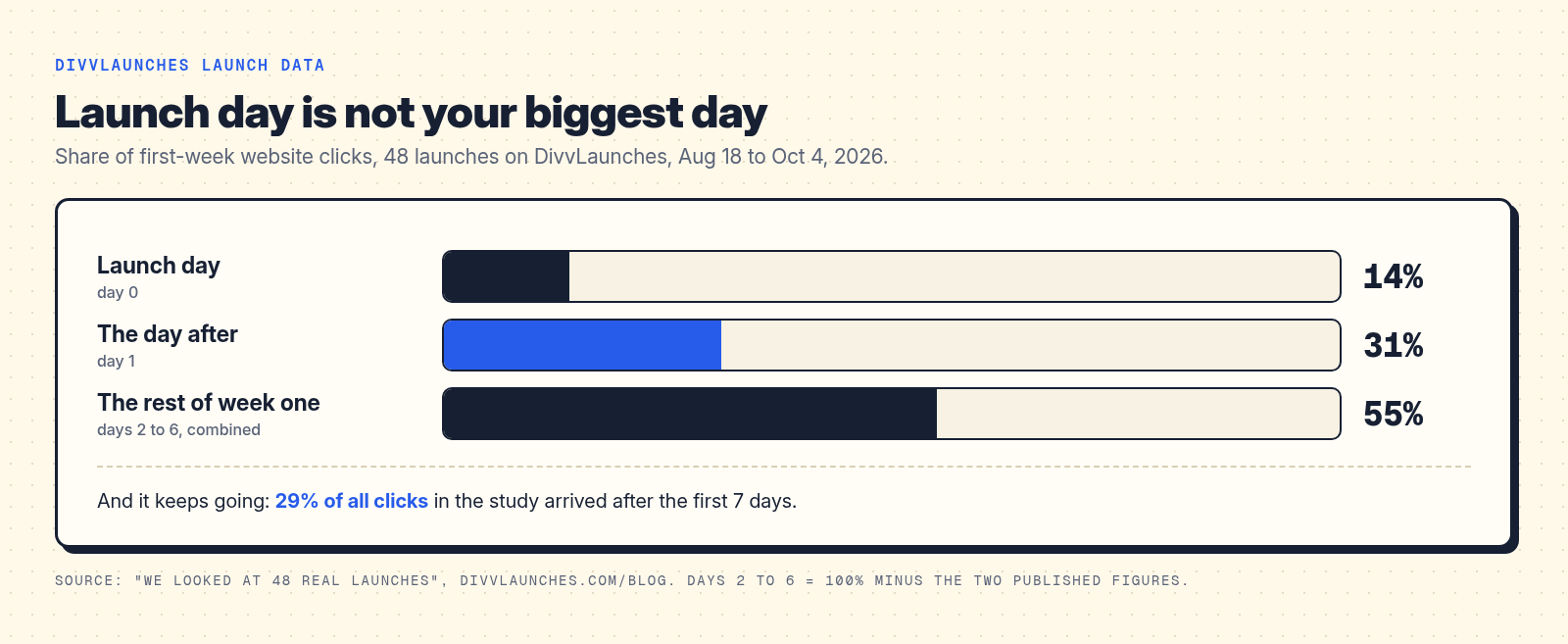
Share of first-week clicks across 48 DivvLaunches launches, Aug 18 to Oct 4, 2026.
Part of it is time zones. The DivvLaunches launch day runs on India time and closes at midnight IST, which is still the afternoon in New York. But the lesson works for any platform: don't post once and disappear. On the day after, post a thank-you, share what people said, and drop the link again.
Step 6: Week three, take the big stage
Now you've fixed what your first users told you, your listing has been tested a few times, and you have something to say. That's when to do Product Hunt or a Show HN.
Product Hunt. Launches go live at 12:01 AM Pacific time, which is 1:31 PM IST while the US is on standard time. You post from a personal account, not a company one. The homepage is curated by the Product Hunt team, so a feature isn't guaranteed, according to Product Hunt's own help pages. Our DivvLaunches vs Product Hunt page has the rest, with a source for each fact.
My honest take: if you have no audience yet, don't make Product Hunt your first launch. It rewards founders who show up with a crowd. Do it in week three, when you have a few users and some comments to point to.
Show HN. Title your post "Show HN: " plus what it does in plain words. Post it yourself, stay around to answer, and write the first comment about why you built it and what's hard about it. Don't ask friends to upvote or comment. The guidelines say outright that it's "not ok on HN".
Whichever you pick, block the whole day. Reply to every comment, including the critical ones.
Step 7: Week four, post a recap with real numbers
The recap is the most underrated post in the whole launch. Share the real numbers: visitors, signups, which platform sent them (your UTM links tell you), and what flopped.
Be specific. A table with each platform, its visitors and its signups, side by side, teaches people something, and it's the kind of post that gets shared. People love honest numbers far more than another launch announcement.
Then link your listings from your own site, like a "Featured on" row in your footer. Listings keep working after launch week. In our study, 29% of all clicks came after the first 7 days.
They also help with AI search. When someone asks ChatGPT for tools like yours, it leans on pages that already list tools in your category: launch platforms, directories and comparison posts. Our explainer on what GEO is covers how to make those listings count.
Mistakes I'd avoid
- Launching everywhere on the same afternoon. You get one small bump and then have nothing left to post about.
- Product Hunt first, with no audience. You use your biggest stage before you've learned anything.
- Polishing the video for another week. On free DivvLaunches launches, listings with and without a video averaged the same 1.9 clicks.
- Asking for upvotes on HN. It's against the rules and it's easy to spot.
- Treating the launch as finished on day one. The day after beat launch day, and the weeks after kept going.
Where DivvLaunches fits
DivvLaunches is a daily launch platform for indie makers. A free launch gets a permanent product page, a link to your site, launch-day voting and a spot in that day's email. You add our badge to your site within 72 hours of booking, and there are 10 free launches a day. First Class is $9.99 once: no badge, top of the board and the first card in the daily email.
The top 3 each day are frozen as Gold, Silver and Bronze on the winners page, so a good day leaves a record you can link to. Plans and prices are on the pricing page.
If you want the whole plan as a checklist, grab the free Launch Kit: a 16-page PDF with a tracker for 25 platforms, tagline formulas and launch-day post templates. For more places to launch, read where to launch your product: 25 platforms.
When your kit is ready, book your launch on DivvLaunches and make it your week-two launch.
FAQ
How long does it take to launch a product?
Plan four weeks from your first directory submission to your recap post, plus about a week before that to write your launch kit and line up where you'll share it.
Should I launch on Product Hunt first?
Only if you already have an audience ready to show up that day. Otherwise launch on directories and maker platforms first, and use Product Hunt in week three.
Can I launch on more than one platform?
Yes. DivvLaunches and Product Hunt don't ask for an exclusive launch. Check each platform's rules, and space your launches a few days apart.
What's the best day to launch?
We don't have enough data to name one. In our study, busy launch days didn't do worse than quiet ones. Pick a day you can be online from start to finish, and keep the day after free too.

Divv Saxena
PILOT IN CHIEFFounder & Flight Director
Guiding indie hackers and startup founders through takeoff, daily community upvoting, and verified directory distribution on DivvLaunches.
Ready to launch your product to early adopters?
Join the daily flight schedule on DivvLaunches. Up to 10 products take off each day at 00:00 UTC with real-time upvoting and permanent podium awards.
CONTROL TOWER RADAR
More Dispatches from Flight School
Pre-flight manuals, launch day blueprints, and founder growth telemetry.
What is Domain Rating (DR) and does it matter for a new site?
Learn what Ahrefs Domain Rating means, how it is calculated, whether Google uses it, and how to grow it the right way as a new maker.

We looked at 48 real launches. Here's what actually got clicks.
We tracked first-week clicks on 48 real launches. Most launch advice made no visible difference, and the day after launch beat launch day.