Soft Launch vs Hard Launch: Which One and When

Divv Saxena
Founder & Flight Director •

On this page
Quick answer
A soft launch releases your product quietly to a small group so you can fix what breaks. A hard launch announces it to everyone at once to get attention. They are not rivals. Most small products should soft launch first and hard launch once strangers can sign up and get value without help.
A soft launch is a quiet release to a limited group: a few users, one country, a beta list. The goal is to learn and fix. A hard launch is a public announcement to everyone at once: launch platforms, your email list, social posts, press if you have it. The goal is attention.
They are two stages, not two options. For most small products the answer is soft launch first, then hard launch when the product can handle strangers. The rest of this page covers how the two differ, six concrete ways to soft launch, and how to tell when it is time to go loud.
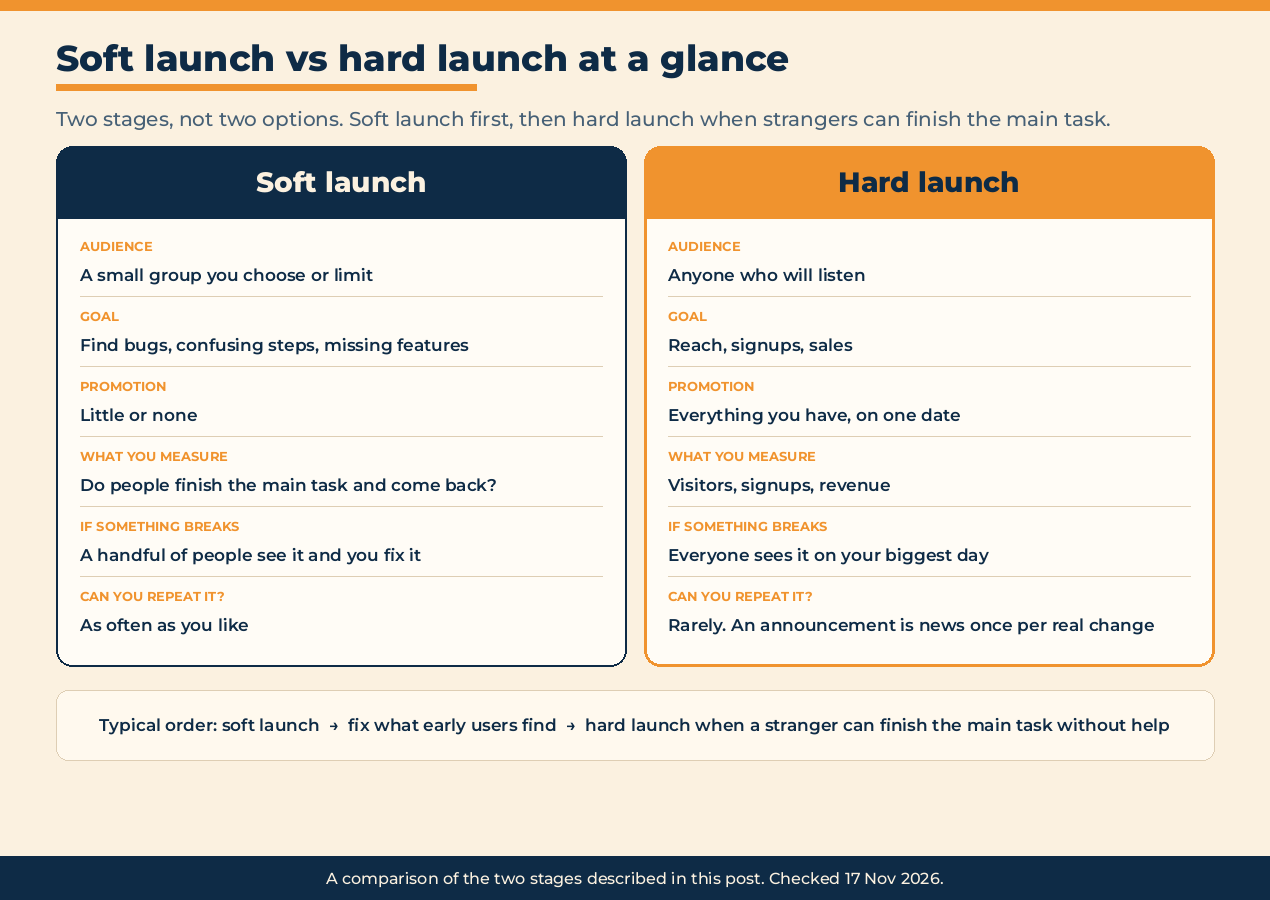
Soft launch vs hard launch at a glance
- Audience. Soft: a small group you choose or limit. Hard: anyone who will listen.
- Goal. Soft: find bugs, confusing steps and missing features. Hard: reach, signups, sales.
- Promotion. Soft: little or none. Hard: everything you have, on one date.
- What you measure. Soft: do people finish the main task, and do they come back? Hard: visitors, signups, revenue.
- If something breaks. Soft: a handful of people see it and you fix it. Hard: everyone sees it on your biggest day.
- Can you repeat it? Soft: as often as you like. Hard: rarely. An announcement is only news once per real change.
That last point is the reason order matters. A soft launch costs you nothing you can't get back. A hard launch spends attention you can't easily ask for twice.
When a soft launch is the right call
- The product is new and nobody outside your circle has used it.
- Signup, payment or onboarding has never been tested by a stranger.
- You are not sure who the product is for yet.
- You have no audience, so a loud launch would land in an empty room.
- A failure would be expensive: payments, data, anything people rely on.
When to hard launch
- Strangers have already signed up and reached the main result without your help.
- You have fixed what early users told you.
- You have somewhere to announce it: an email list, followers, a community you are part of.
- There is a date reason: an event, a season, a competitor's move.
- The product is simple and low risk, and waiting teaches you nothing.
Skipping the soft launch is fine in that last case. A small free tool with no accounts and no payments has little to test in private.
Six ways to soft launch
1. Invite people by hand. Send the link to ten people who have the problem. Watch where they get stuck. This is the cheapest version and it works for any product.
2. A waitlist with small batches. Let people in a few at a time. One caution if Product Hunt is in your plans: its Featuring Guidelines say it does not feature waitlisted products "unless immediate access is provided" (checked 17 Nov 2026). So open the doors before that launch.
3. A beta through TestFlight (iOS). Apple's TestFlight lets you invite up to 10,000 external testers by email or a public link, after your first build passes TestFlight's App Review (checked 17 Nov 2026).
4. One country or region first. App stores let you choose where an app is available. Releasing in one smaller market lets you test the listing and the product before the markets you care most about.
5. A phased release for updates (iOS). For version updates, Apple's phased release can roll a release out over 7 days to 1%, 2%, 5%, 10%, 20%, 50% and then 100% of users with automatic updates on, and you can pause it for up to 30 days in total (checked 17 Nov 2026). This is for updates, not for the first version of an app.
6. Smaller launch platforms and directories first. Post where the stakes are lower before the big stage. A smaller launch board is public, so it is not a pure soft launch, but it is a way to test your tagline, screenshots and signup flow with real visitors. That is the order we suggest in how to launch a product: directories, then maker platforms, then the big stage.
Don't use your biggest stage as the soft launch
Some platforms limit how often you can come back. Product Hunt's launch FAQ says you can launch again "every time you ship a major update", and that a launch within two months of your last one needs a relaunch request (checked 17 Nov 2026). A quiet test run there uses up a launch you would want later.
The same goes for your own email list. People open "we are live" once.
A checklist for going from soft to hard
You are ready to hard launch when you can tick most of these:
- A stranger can sign up and reach the main result without a call or a message from you
- Signup and payment work in production, tested in a clean browser
- You have fixed the top three problems from early users
- At least a few people came back a second time on their own
- You can say what the product does in one sentence, and early users repeat it back
- Your listing is ready: tagline, screenshots, description, a short story of why you built it
- You know the date and the places you will announce it
- You can be online that day to answer questions
If you want a number for the listing part, our free launch readiness checker scores your launch details before you submit. And if most of the list is still unticked, the work is finding early users, which is what how to get your first 100 users covers.
Common mistakes
- A soft launch that never ends. "Still in beta" for a year is usually fear of the hard launch. Set an end condition, such as the checklist above.
- A hard launch with no soft launch. The first real traffic finds the broken signup.
- Calling it a soft launch after a hard launch flops. People can tell. Fix what was wrong and launch again when there is a real update to announce.
- Treating the hard launch as the finish line. It is one day. What you do with the users and feedback afterwards matters more.
For the big-stage part specifically, how to get featured on Product Hunt explains what its team looks for.
When you are ready to announce, you can also launch your product on DivvLaunches. A free listing includes a nofollow link. A First Class listing is $9.99 (checked 17 Nov 2026) and the link is marked rel=sponsored.
FAQ
What is a soft launch?
A release to a limited audience with little or no promotion, done to test the product and fix problems before a wider announcement.
What is a hard launch?
A full public release announced to everyone at once, with all your promotion aimed at one date.
Is a beta the same as a soft launch?
A public or private beta is one way to soft launch. A soft launch can also be a single country, a small invite list or a quiet release with no label at all.
Can you do a hard launch more than once?
Yes, when there is something new to announce. Product Hunt, for example, allows a new launch for each major update.
How long should a soft launch last?
There is no standard length. End it on a condition, not a date: when strangers complete the main task without help and the biggest reported problems are fixed.

Divv Saxena
PILOT IN CHIEFFounder & Flight Director
Guiding indie hackers and startup founders through takeoff, daily community upvoting, and verified directory distribution on DivvLaunches.
Ready to launch your product to early adopters?
Join the daily flight schedule on DivvLaunches. Up to 10 free launches take off each day at 00:00 IST (India time), with live upvoting until midnight and a permanent podium for the top 3.
CONTROL TOWER RADAR
More Dispatches from Flight School
Pre-flight manuals, launch day blueprints, and founder growth telemetry.
How to Launch on Product Hunt in 2026 (and Where to Launch Next)
How to launch on Product Hunt in 2026: the current rules (no Launch Now, a one-week account wait, 30-day scheduling), the steps, a check of its link markup, and where to launch next.

Best Time to Launch on Product Hunt (by Time Zone)
You don't pick a time on Product Hunt. Every launch goes live at 12:01 AM Pacific Time on the date you schedule and runs until midnight Pacific. What you pick is the day, and Product Hunt says no weekday guarantees a top spot. Choose the day you can be online for.